Tiny House Rules: Building Codes, Zoning and Appendix Q
A tiny house has to satisfy two different sets of rules: the building code and local zoning. Here is what Appendix Q of the International Residential Code covers, what it does not, and how to check your area.
By Home Crane Editors. . 3 min read.
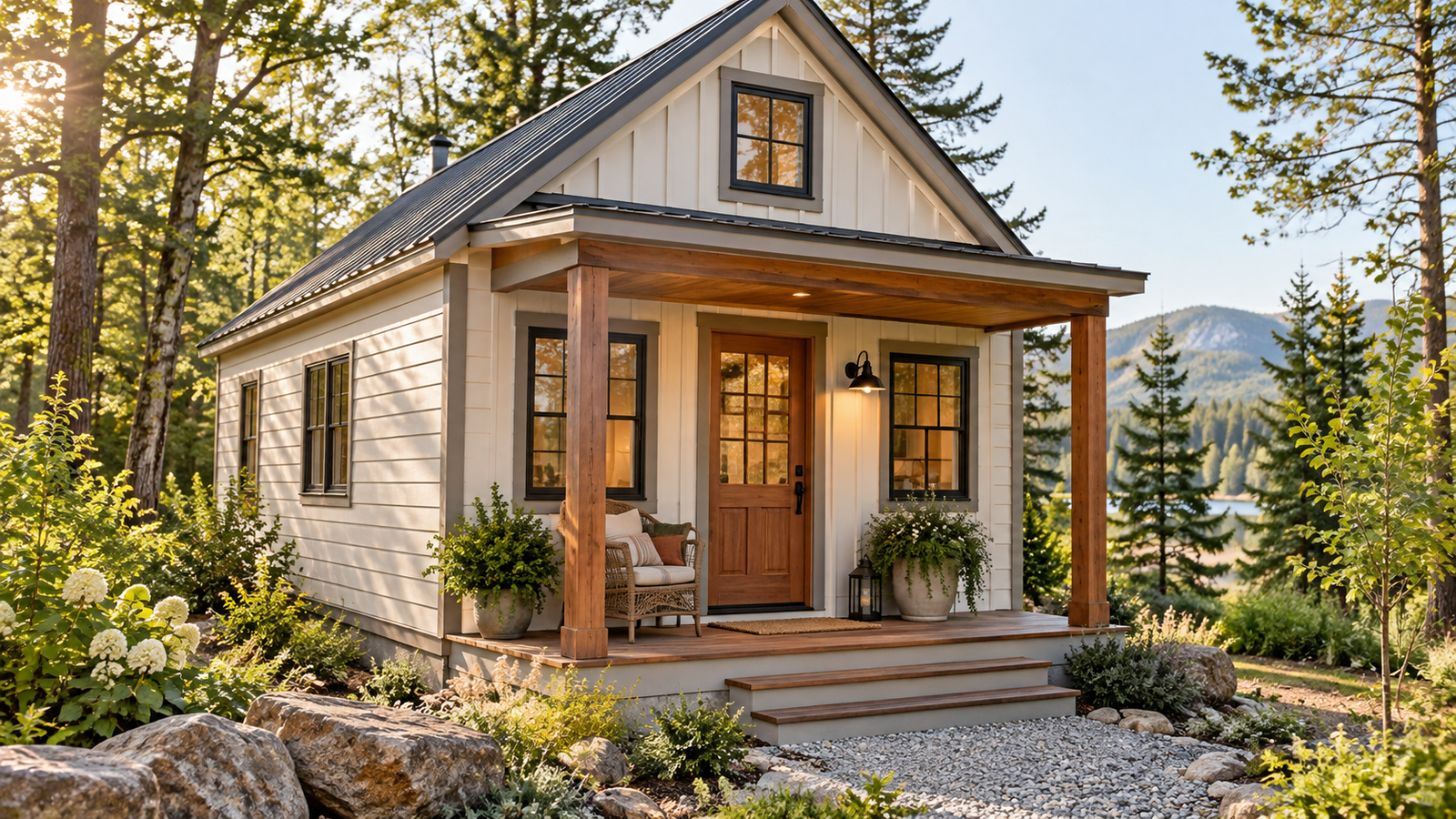
Conceptual illustration of a small house on a foundation. Not a code-compliant design.
Two separate sets of rules decide whether a tiny house can be built and lived in. The building code sets how it must be built, and zoning sets where and how it may be used. For tiny houses on a foundation, the model building code has a dedicated section, Appendix Q of the 2018 International Residential Code (IRC), but it only applies where your state or city has adopted it. Check both rules with your local building department before you buy plans.
What counts as a tiny house in the code
The International Code Council's own summary of the appendix, published on iccsafe.org, describes the section structure: AQ101 covers scope, AQ102 gives definitions, and AQ103 through AQ106 cover ceiling height, lofts, emergency escape openings and energy conservation. It defines a tiny house as a dwelling of 400 square feet or less in floor area, excluding lofts, and applies to homes on a foundation. Tiny houses on wheels fall outside it, and the rules for those come from other regimes that differ by state and city.
The appendix exists because the regular code was written with larger rooms in mind. Appendix Q relaxes several requirements for tiny houses, with particular attention to compact stairs, ladders, reduced ceiling heights in lofts, and guard and emergency escape openings at lofts, as the Tiny Home Industry Association summarizes.
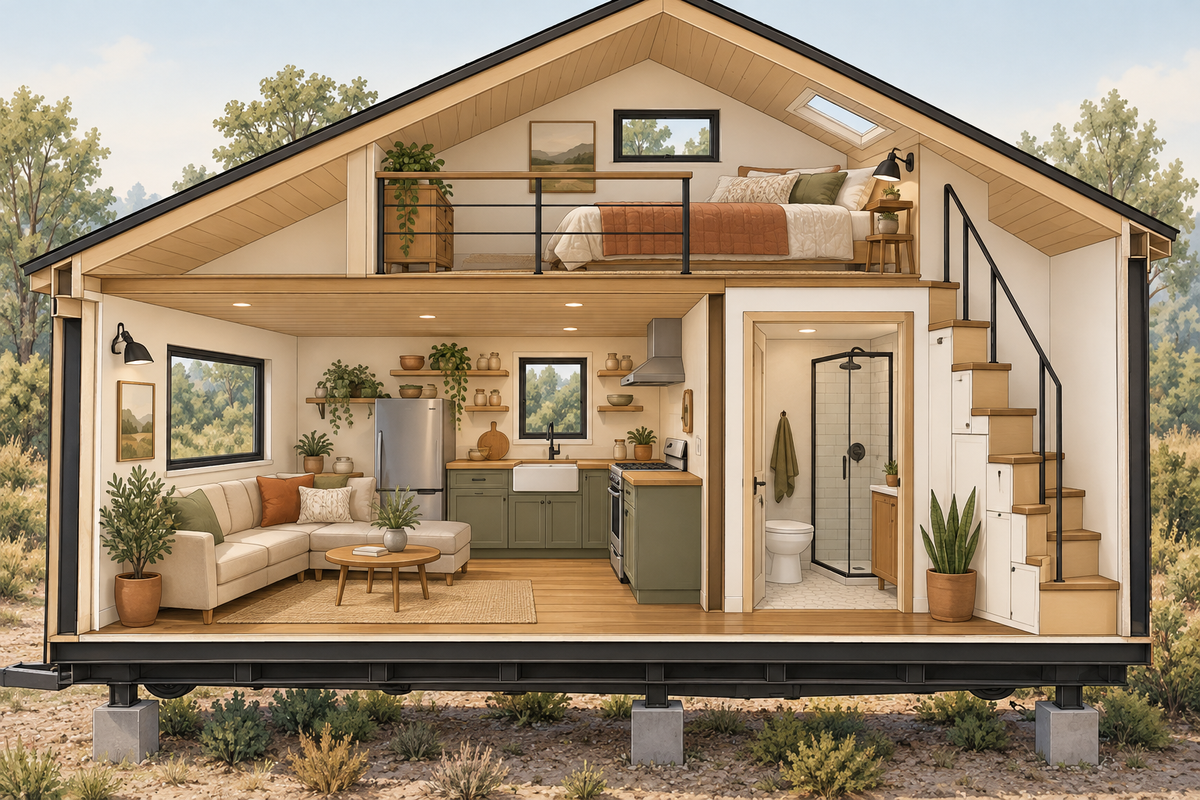
The ceiling height rules, as an example
Ceiling height is one of the clearest differences, and it falls under section AQ103, which ICC's own summary confirms covers ceiling height. A secondary summary from Building Code Trainer gives the specific subsection AQ103.1:
| Feature | Minimum height | |
|---|---|---|
| Habitable spaces and hallways | 6 feet 8 inches | |
| Bathrooms, toilet rooms and kitchens | 6 feet 4 inches | |
| Lofts | May be lower. No minimum stated |
Do not build from this summary. It shows why Appendix Q matters, but the adopted text in your area, which may include local amendments, is what your inspector will use.
Appendix Q is not automatic
A model code is not law until a government adopts it. The appendix itself is not mandatory unless a state or municipality adopts it, and jurisdictions may amend it. That produces a patchwork. The Tiny Home Industry Association's legislation tracker lists Maryland with an effective date of January 1, 2023, and Nevada with January 16, 2023. In Montana, the state adopted Appendix Q effective December 6, 2019, while each local jurisdiction may choose whether to adopt it too.
That tracker is maintained by an industry association, so confirm any listing with the state or city itself. Where a place has not adopted Appendix Q, the same industry sources note that builders can seek approval of a project through the code's alternative materials and design provision. That is a decision made by the local building official, not a right.
Zoning is a different question
Even a code-compliant tiny house needs somewhere it is allowed to be. Zoning controls what can be built on a lot, and some places set minimum dwelling sizes or lot requirements that a very small home may not meet. One common legal path for a second small home on an existing lot is as an accessory dwelling unit, and some places explicitly allow tiny homes in that role. Port Townsend, Washington, for example, allows tiny homes on wheels as detached ADUs according to the Municipal Research and Services Center. Read our guide to accessory dwelling units for the questions to ask.
| Feature | First question to ask | |
|---|---|---|
| Backyard of an existing home | Does zoning allow an ADU, and can a tiny house qualify as one? | |
| Its own lot | Are there minimum home sizes or lot rules, and is Appendix Q adopted? | |
| On wheels | Which state and local rules apply to movable dwellings, and where can it be parked and lived in? |
Factory-built and business uses: one state's example
Montana's adoption shows how details can matter. The Tiny Home Industry Association's summary of the Montana rule says its department applies Appendix Q to factory-built buildings that meet the tiny house definition. It also says tiny houses do not meet the building code requirements for commercial or business occupancy, so they are prohibited for those uses in that state. Another state may treat prebuilt units and business uses differently, which is why a purchase from a builder in one state does not guarantee approval in yours.
When you read an adoption notice, check four things: which edition of the code was adopted, whether Appendix Q is included or excluded, what local amendments apply, and the date it takes effect. A project permitted last year can be under different rules from one permitted next year.
Questions for your building department
- Has this jurisdiction adopted the 2018 IRC or later, and is Appendix Q adopted, amended or excluded?
- Are there minimum dwelling sizes or lot sizes in my zone?
- Would a tiny house count as an ADU, a primary dwelling or something else?
- What plans, engineering and inspections are required?
- If I buy a prebuilt or factory-built tiny house, how is it reviewed?
Your takeaway: before you fall for a set of plans, call your building department with two questions. Is Appendix Q adopted here? And does zoning allow a home this size on my lot? Their answers decide the rest of your project.
Frequently asked questions
Does Appendix Q apply to tiny houses on wheels?
Appendix Q covers tiny houses on a foundation. Tiny houses on wheels are outside it and are governed by other rules that vary by state and city.
Is Appendix Q the law everywhere?
No. It is a model code provision that a state or city must adopt, and adopters may amend it.
Sources
- Adoptable Appendices in the International Residential Code for Cob Construction and Tiny Houses, International Code Council. Checked September 29, 2026
- Tiny House Regulations per Appendix Q, Building Code Trainer. Checked September 24, 2026
- 2018 International Residential Code (IRC) Phoenix Amendments, Appendix Q Section AQ102, City of Phoenix. Checked September 29, 2026
- Appendix Q: Tiny Houses On A Foundation, Tiny Home Industry Association. Checked September 24, 2026
- Residential Building Code, 2018 IRC and Appendix Q (Maryland), Tiny Home Industry Association. Checked September 24, 2026
- Residential Building Code, 2018 IRC and Appendix Q (Nevada), Tiny Home Industry Association. Checked September 24, 2026
- Montana Adopts Appendix Q Tiny House, Tiny Home Industry Association. Checked September 24, 2026
- Accessory Dwelling Units (ADUs), Municipal Research and Services Center (Washington). Checked September 24, 2026
Share this article
Get new guides by email
Practical home articles and free resources. No spam, and you can unsubscribe at any time.