Deck Safety Inspection: What to Check Before Each Season
Most deck failures start in a few predictable places. Here is a homeowner's visual checklist, the warning signs that mean stop using the deck, and when to call a professional.
By Home Crane Editors. . 4 min read.
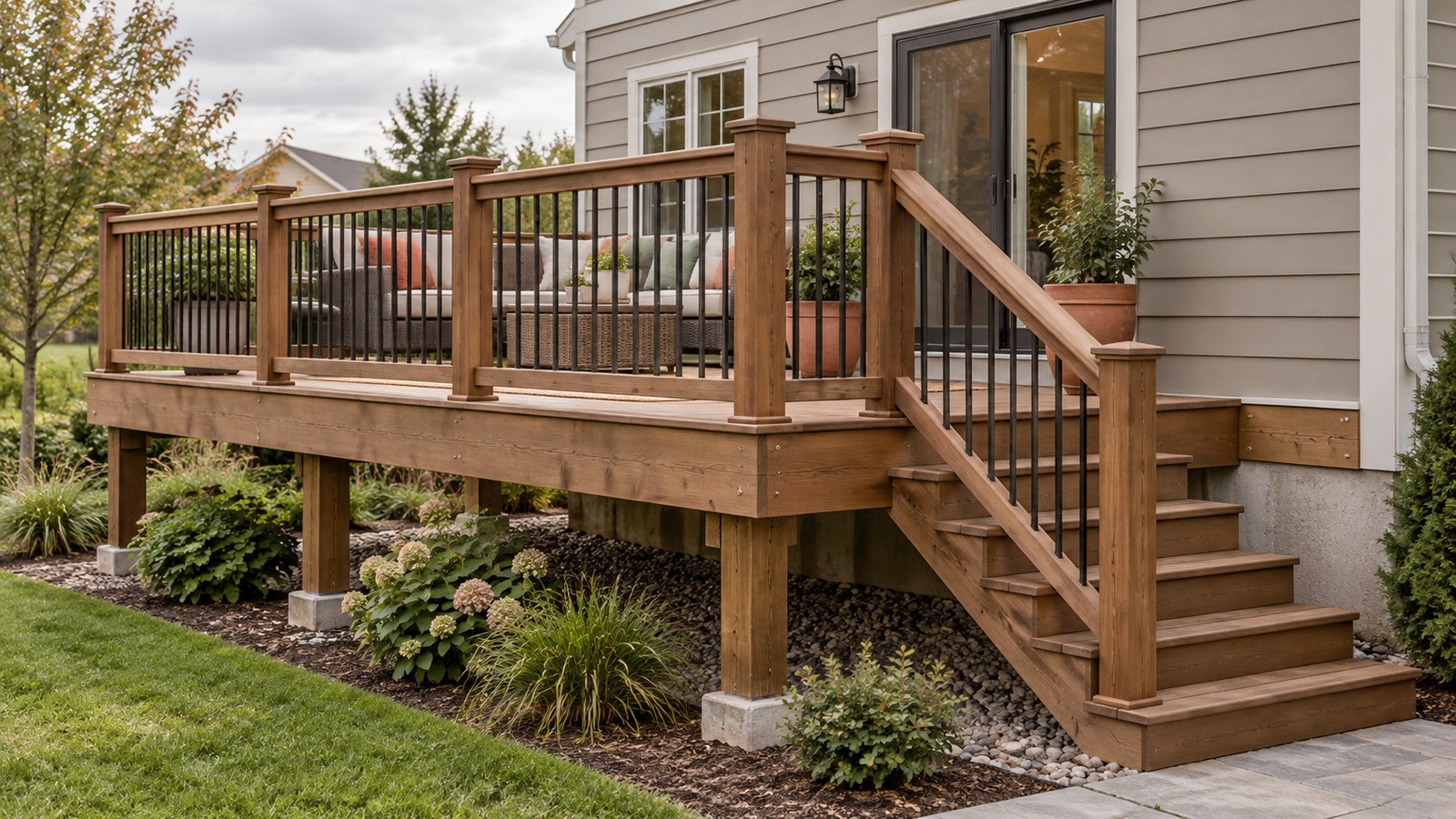
Conceptual illustration. The connection to the house is the first place to look.
Look at where the deck attaches to the house first, then at the posts and footings, the framing, the stairs, the boards and the railings. Fine Homebuilding says an annual inspection takes less than an hour, and it is worth doing every season. This guide covers what a homeowner can safely check by eye. Repairs to structural parts are a job for a qualified contractor, and any deck that moves underfoot should not be used until it has been checked.
Why the connection to the house comes first
The ledger board is the piece that bolts the deck to the house wall. Fine Homebuilding calls it a common site for deck failure and says it deserves particular attention on decks more than three feet off the ground, where a collapse can cause serious injury. It also says ledgers must be bolted or screwed securely to the house, not just nailed, because nails tend to pull out.
The North American Deck and Railing Association (NADRA) says the same from a different angle. Its inspection checklist, described by Pro Builder, notes that older decks are particularly susceptible to pulling away from the home if this connection was installed incorrectly or has corroded. A separate report on NADRA guidance names two areas that typically contribute to collapses: railings and the connection to the house.
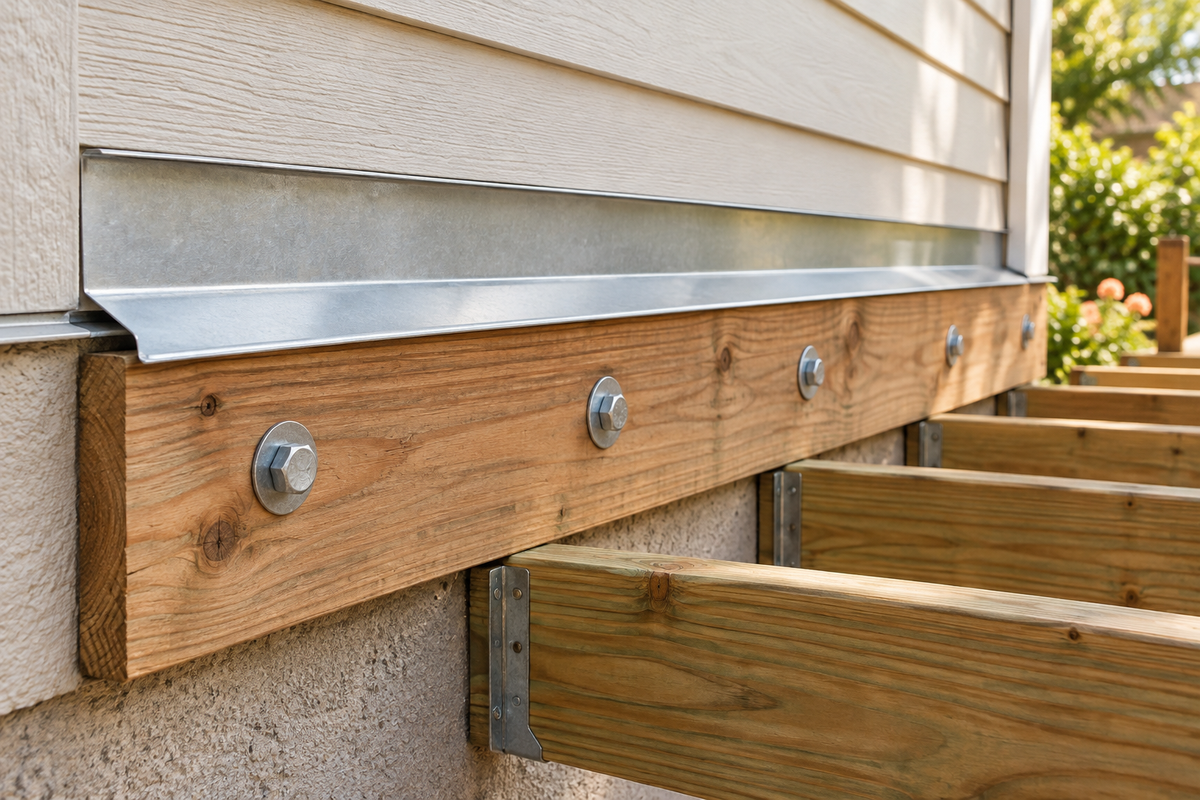
A seasonal checklist
Pro Builder lists NADRA's eight inspection areas, and a lumber retailer's seasonal checklist adds simple checks a homeowner can do. Combined into one table:
| Feature | Warning signs | Who fixes it |
|---|---|---|
| Ledger and house connection | Gaps, loose bolts, water stains behind the ledger, nails as the only fasteners, corrosion | Qualified contractor |
| Footings and posts | Cracked or shifted footings, leaning posts, soft wood at the base | Contractor |
| Joists, beams and hardware | Rot, cracks, rusted or loose hangers, sagging | Contractor |
| Stairs | Loose treads, corroded connections, gaps at the guard bottom of 6 inches or more | Contractor for structure. Simple tightening by owner |
| Deck boards | Loose or raised fasteners, cracked or soft boards, wrong spacing for composite | Owner or contractor |
| Railings | Wobble, low height, loose posts | Contractor |
Two figures in the list are worth knowing, both from NADRA's checklist as reported by Pro Builder. The opening between the riser, tread and guard bottom on stairs should be less than 6 inches, and railings should be at least 36 inches tall and ideally 42. Local code sets the legal requirement, so treat these as reference points.
Simple tests you can do yourself
- Probe wood with a screwdriver. If the tip sinks in easily at post bases, railings or joist ends, the wood is soft and likely rotted.
- Feel for movement. Walk the deck and push on the railing at several points. Wobble is a warning sign. Advantage Lumber's checklist says to call a professional immediately if you notice movement when stepping onto the deck.
- Look at metal. Rust on fasteners and connectors means moisture has been getting in.
- Look at the ground under the deck for pooled water, debris against the framing and signs of insects.
When to bring in a professional
Pro Builder notes that homeowners who want a more thorough assessment can ask a contractor for a professional inspection, and that NADRA has produced a four-page checklist for contractors to document concerns across the eight areas above. That gives you something concrete to ask for. When you call, you can ask whether the inspector uses a standard checklist and whether you will get the findings in writing.
- Ask for a written list of problems ranked by urgency, so you can separate safety issues from cosmetic ones.
- Ask whether each repair needs a permit and an inspection in your town.
- For any major structural repair, consider getting a second opinion or more than one quote. That is our suggestion, not a rule, but the price of a second look is small next to the cost of a wrong diagnosis.
- Keep the report. It becomes part of your home maintenance records and is useful when you sell.
Hold off on cosmetic work such as staining or sealing until structural problems are settled. Refinishing a deck with a failing ledger only makes a hazardous deck look better.
How old is too old?
Age matters, but numbers vary. Fine Homebuilding, citing NADRA, says at least 30 people died in deck collapses between 2000 and 2008 and that 40 million decks in the United States are more than 20 years old. Other publications give different counts of decks and injuries for different periods. Because these statistics do not agree, use them only to see that this is a real and common problem, and rely on the physical condition of your deck instead. The Money Pit, reporting on NADRA guidance, says many failing decks were built incorrectly, poorly maintained or past a lifespan of roughly 10 to 15 years. Treat that as a rough guide, since materials and climate change it.
Plan for the cost of upkeep or replacement
Decks need regular attention and eventually replacement. Put the item in your yearly maintenance plan, using our guide to budgeting for home maintenance. If you are thinking about replacing surface boards, the deck calculator estimates boards and joists for a rectangular deck, but it is a materials takeoff, not a structural design. Framing size, spans, footings and the house connection must be designed to your local code, and many places require a permit. Ask your building department before starting.
Your takeaway: pick a dry weekend before the season, take a flashlight and a screwdriver, and walk the checklist in the table. Photograph anything that worries you and get a contractor's opinion before the deck sees a crowd.
Frequently asked questions
How often should I inspect my deck?
At least once a year. Fine Homebuilding says a thorough annual inspection takes less than an hour, and NADRA promotes checking every spring.
Can I repair a loose ledger myself?
Structural connections such as the ledger, footings and posts should be evaluated and repaired by a qualified contractor, and repairs may require a permit.
Sources
- Is Your Deck Safe?, Fine Homebuilding. Checked September 24, 2026
- Deck evaluation checklist, Pro Builder. Checked September 24, 2026
- Preventing Deck Collapse, The Money Pit. Checked September 24, 2026
- Deck Safety Month: Your Essential Checklist, Advantage Lumber. Checked September 24, 2026
Share this article
Get new guides by email
Practical home articles and free resources. No spam, and you can unsubscribe at any time.
Keep reading

The Best Deck Materials for Virginia Weather
Compare composite, PVC, pressure-treated wood, and naturally durable decking for Virginia weather, including maintenance and installation trade-offs.
October 2026, 4 min read
Massachusetts Deck Building Cost: Wood vs. Composite
Compare Massachusetts wood and composite deck costs, installed scope, maintenance, and a clear sample budget with illustrated quote-planning guidance.
October 2026, 4 min read