How Much Does a Sunroom Addition Cost in Virginia?
Compare Virginia seasonal and year-round sunroom costs, local contractor ranges, foundations, glazing, approvals, and an illustrated sample budget.
By Home Crane Editors. . 4 min read.
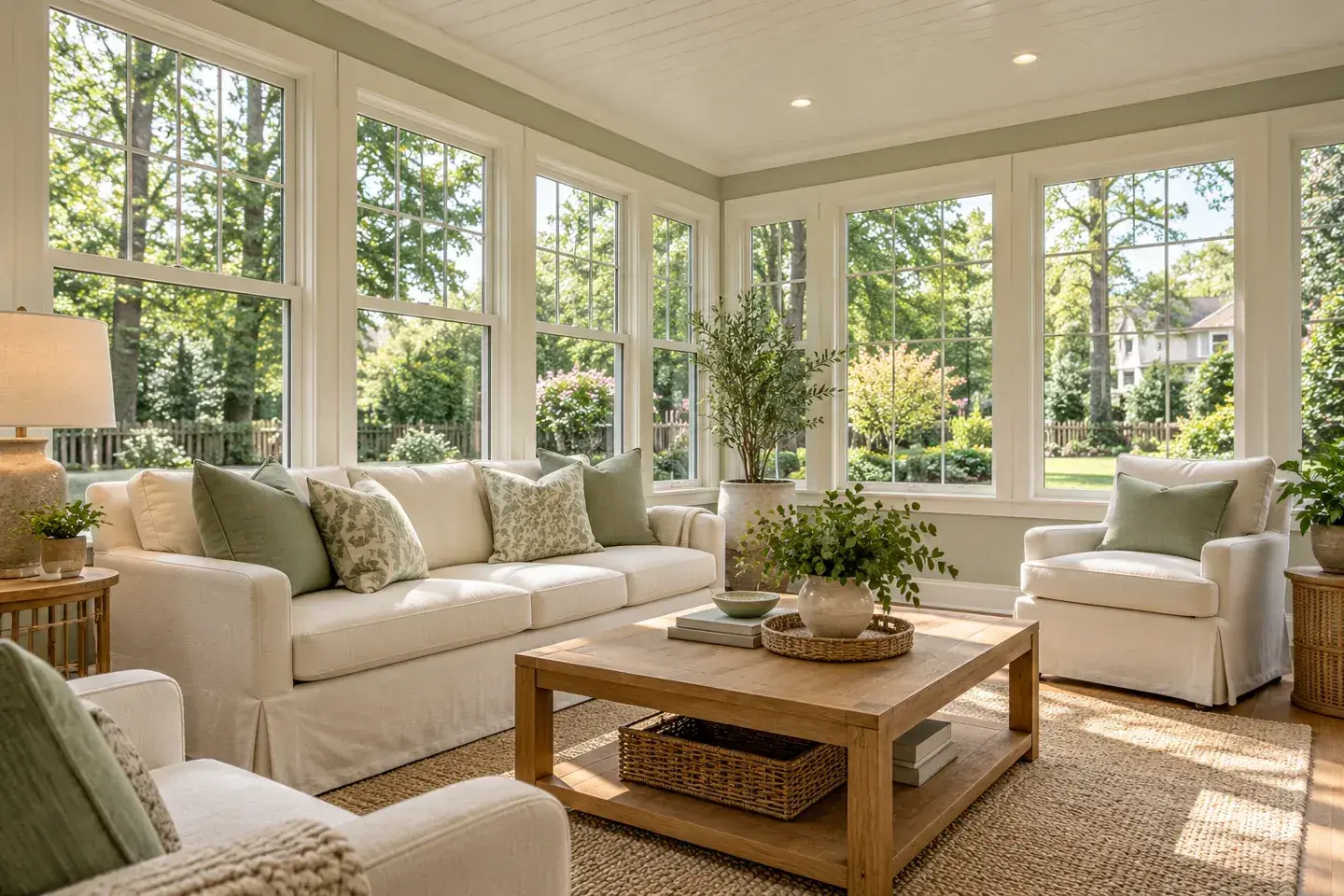
A Virginia sunroom can mean a seasonal enclosure or a fully conditioned room built as part of the house. That distinction matters more than the label on a contractor's brochure. Published local examples vary from $25,000 to $45,000 for a Richmond-area seasonal project to six-figure custom additions in Northern Virginia.
Those figures describe different markets and scopes. They should not be averaged into a supposedly typical Virginia price. Start by choosing how you will use the room, then price the structure, glazing, house connection, utilities, and approvals together.
1. Choose seasonal or year-round use
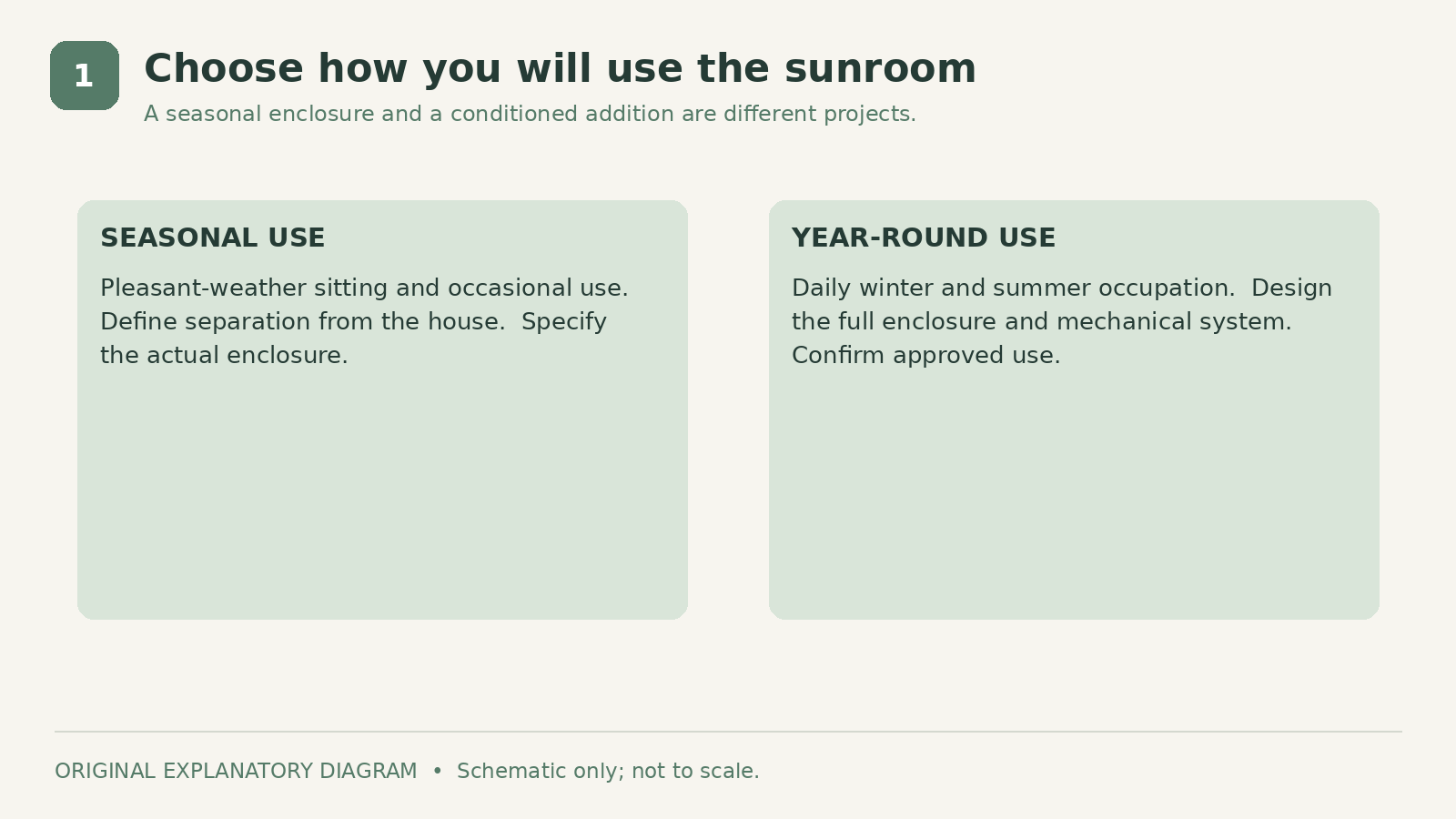
Write a short description of a normal day in the future room. Will it hold morning coffee and occasional guests in pleasant weather, or become the place where you work every weekday in January? The second goal calls for a different design conversation.
A seasonal sunroom may remain separated from the conditioned house by an exterior-quality door. A year-round room needs the design team to address the full enclosure and heating or cooling strategy. Do not assume that adding a portable heater turns a seasonal enclosure into approved habitable space.
List furniture before choosing dimensions. A dining table with chairs pulled out takes more room than the tabletop alone. Include circulation from the existing house to any garden door, and identify where glare could interfere with a screen or reading chair.
Ask the designer to explain how the proposed classification affects the drawings and approvals. Keep the answer with the proposal. Labels such as “three-season” and “four-season” are useful descriptions, but the actual construction specification is what you are buying.
2. Read Virginia price ranges by market and scope
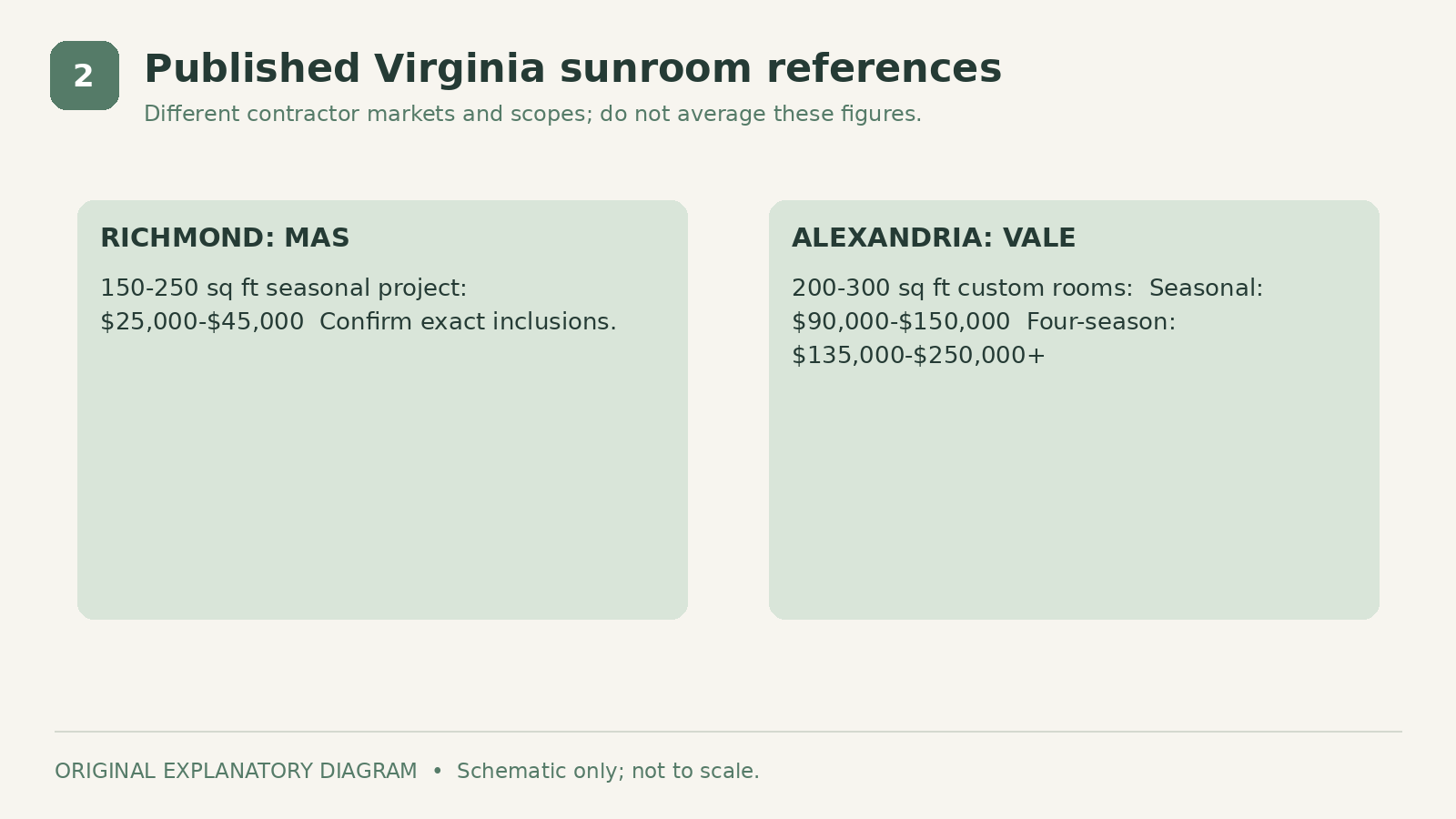
MAS Contractors' Richmond addition guide lists a 150-to-250-square-foot sunroom or three-season addition at $25,000 to $45,000. It is contractor-published local planning guidance, not a statewide survey or a guaranteed complete quote.
Vale Construction's Alexandria sunroom guide describes a substantially different custom market: $90,000 to $150,000 for a 200-to-300-square-foot three-season room and $135,000 to $250,000 or more for a four-season version. Its stated packages include substantial new construction.
| Feature | Scope to confirm | |
|---|---|---|
| Richmond seasonal range | Exact enclosure, foundation, finishes, and exclusions | |
| Alexandria custom seasonal range | New structure, glazing, electrical work, and house integration | |
| Alexandria four-season range | Conditioned enclosure, mechanical system, and complete finishes |
These references establish why the word “sunroom” alone cannot produce a useful price. They do not prove that one region always costs a fixed percentage more or that either contractor's range applies to your home.
Request a local concept estimate before investing in detailed selections. Show the expected season of use and ask the builder which published category, if any, resembles the proposed work.
3. Assess the foundation and house connection
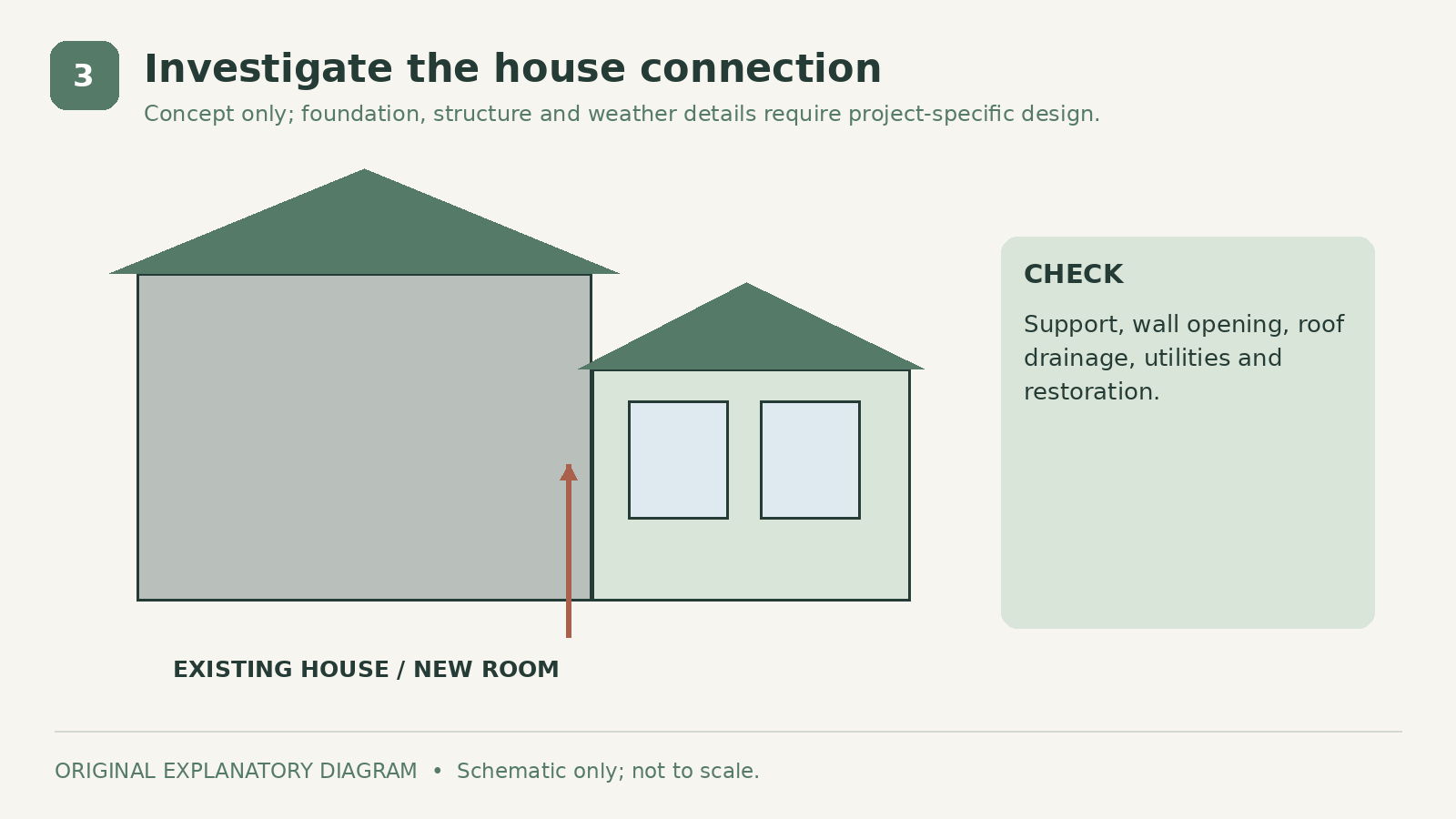
An existing patio or deck should not be treated as an automatically suitable foundation. Have the designer assess its construction, condition, and ability to serve the proposed addition. If it cannot be reused, include removal and a new support system in the budget.
The connection to the house can change several trades at once. Opening an exterior wall may affect structure, interior finishes, utilities, and weather protection. Ask the team to identify those interfaces instead of pricing only the new room's outer walls.
Roof shape deserves attention before choosing the prettiest rendering. Request a design that explains water drainage, flashing responsibility, and how the addition meets the existing exterior. The article illustrations are design concepts, not verified roof or foundation details.
For a conditioned room, ask for a heating and cooling assessment based on the proposed glazing and exposure. A large amount of glass can change comfort even when the floor area seems modest. Specify shades, operable windows, or other comfort features where the designer recommends them.
Finally, walk the delivery route. Decide where materials, equipment, and temporary protection will go without blocking essential access to the house.
4. Build a complete sunroom budget
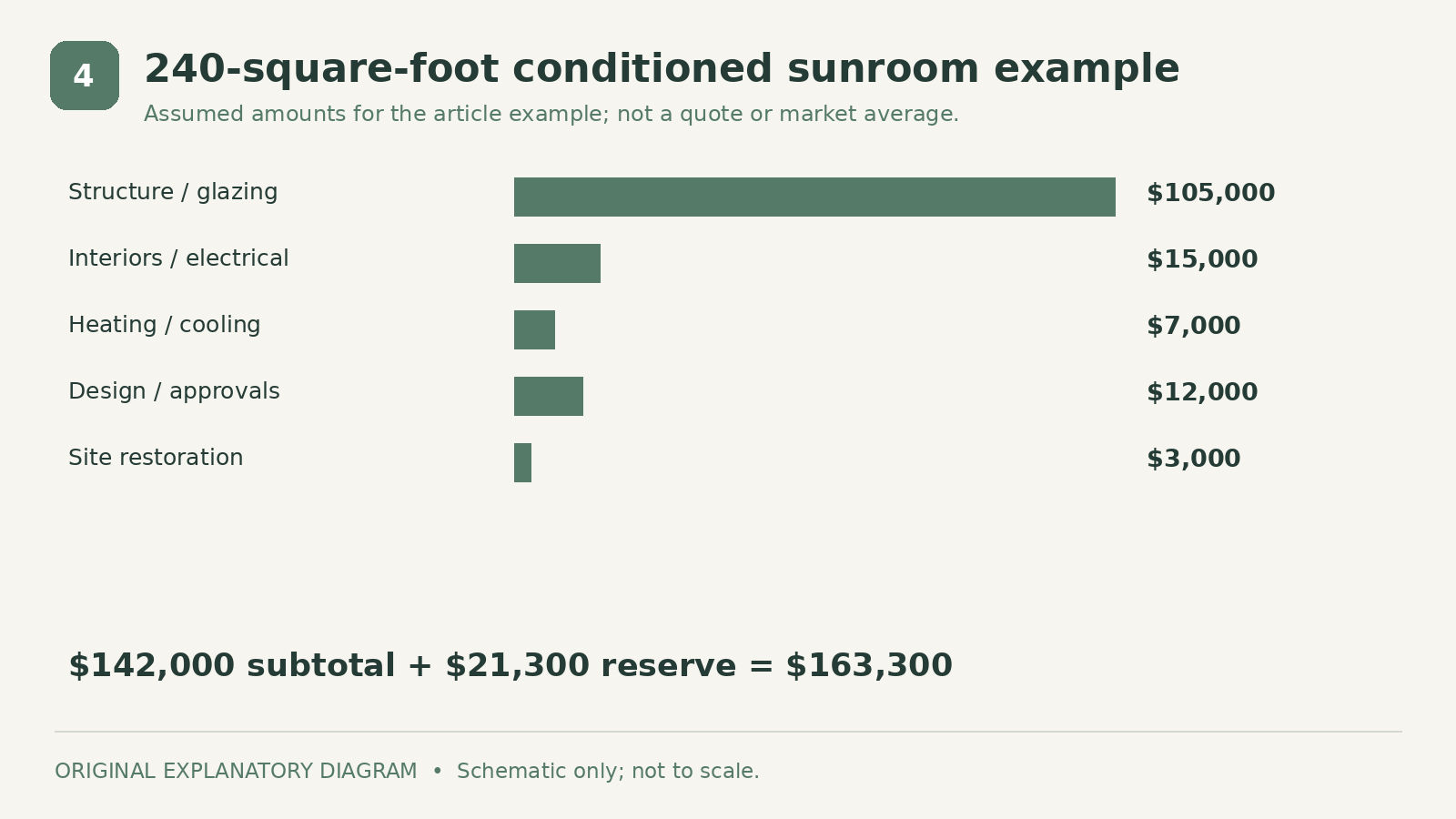
The following is an original planning example for a custom, approximately 240-square-foot conditioned addition. It uses assumed purchasing amounts and is not a quote, a contractor's completed project, or an average for Virginia.
| Feature | Assumed amount | |
|---|---|---|
| Structure, foundation, glazing, and exterior | $105,000 | |
| Interior finishes and electrical work | $15,000 | |
| Dedicated heating and cooling allowance | $7,000 | |
| Design, engineering, and approvals | $12,000 | |
| Site restoration | $3,000 | |
| Subtotal | $142,000 | |
| Owner reserve, 15% | $21,300 | |
| Planning total | **$163,300** |
The construction-related allowances are deliberately grouped to make scope visible. If your contractor bundles interior finishes or mechanical work into the first line, remove the overlapping allowance. Furniture, financing, unusual retaining work, and major repairs to the original house are excluded.
The reserve is an example, not a universal recommendation. Set the amount with the project team after discussing unresolved conditions. A larger uncertainty should prompt investigation, not simply a larger unexplained cushion.
To reduce the total, request priced alternatives for size, roof complexity, glazing packages, and season of use. Compare how each change affects the way you intend to use the room. Removing essential weatherproofing or structural work is not a sensible economy.
5. Compare plans, approvals, and handover
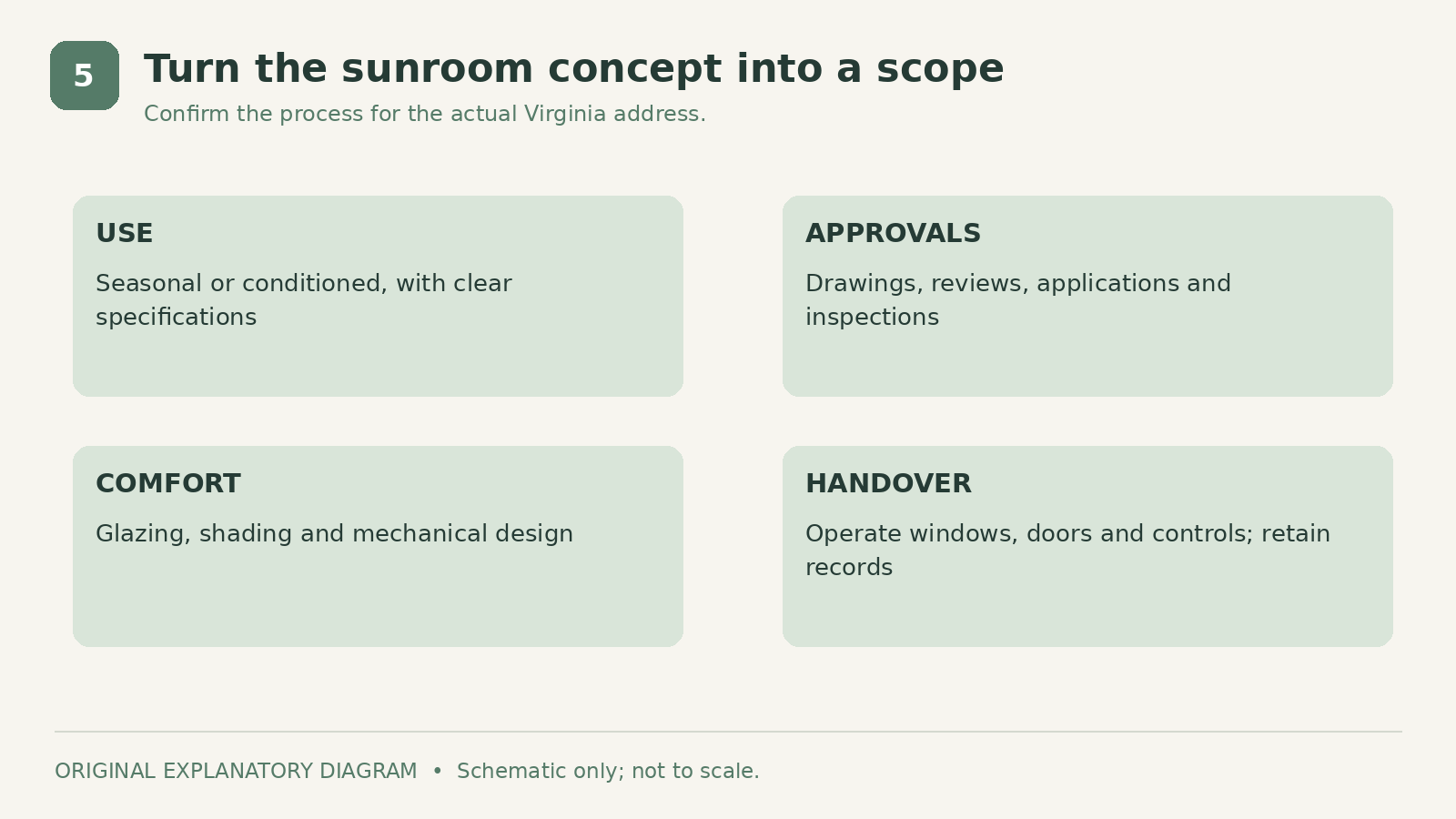
Fairfax County's permit guidance includes sunrooms among additions requiring permits. Its residential addition process also identifies site and planning considerations. These are Fairfax references; confirm the process with the authority responsible for your own Virginia address.
Ask who manages drawings, applications, inspections, and corrections. If the house is subject to historic review, association rules, or other restrictions, resolve the applicable review before ordering custom components. Do not rely on a generic estimate for approval timing.
A useful contract identifies the room's intended use, exact window schedule, finishes, mechanical scope, payment milestones, and change process. It also states who restores the garden and removes temporary protection.
Before final handover, collect product instructions, warranties, inspection records, and the agreed list of outstanding items. Operate doors, windows, controls, and shades with the installer present. The best sunroom budget buys a space that meets the original use brief and has a clear route for resolving any remaining work.
Sources
- MAS Contractors' Richmond addition guide. Checked October 7, 2026
- Vale Construction's Alexandria sunroom guide. Checked October 7, 2026
- Fairfax County's permit guidance. Checked October 7, 2026
- residential addition process. Checked October 7, 2026
Share this article
Get new guides by email
Practical home articles and free resources. No spam, and you can unsubscribe at any time.
Keep reading
How Much Does a Home Addition Cost in Maryland?
Plan a Maryland home addition with local cost context, building options, design and site allowances, and a transparent 400-square-foot sample budget.
October 2026, 4 min read
Planning a Home Addition: Setbacks, Zoning and Questions to Ask First
A home addition has to fit inside invisible lines set by local zoning long before it has to satisfy a single design preference. Here is what setbacks, lot coverage and height limits mean, and how to check them for your property.
September 2026, 3 min read