Cost Guide: Replacing Old Cast Iron Drain Plumbing With PVC
Budget for cast iron drain replacement with PVC using a US cost benchmark, a transparent sample budget, and questions for comparing contractor quotes.
By Home Crane Editors. . 5 min read.

Replacing old cast iron drain plumbing with PVC does not have one reliable national price. A short, accessible drain section and a concealed stack serving several floors are different projects. The most useful budget begins with the exact section, its access conditions, and everything that must be restored afterward.
As a broad US reference, HomeGuide's drain-pipe cost guide, updated February 6, 2026, reports $150 to $250 per linear foot for drain-pipe replacement including materials and labor. This is a general drain-replacement benchmark, not a cast-iron-to-PVC quote or a promise for your home.
This article covers drain, waste, and vent plumbing, often abbreviated DWV. It does not estimate replacement of drinking-water supply pipes, a municipal sewer main, or every pipe in a house. Keep those scopes separate when comparing search results and contractor proposals.
What the Price Needs to Include
A complete quote should explain demolition, pipe removal, new pipe and fittings, appropriate transitions, support, testing, and required inspections. It should also identify whether wall, ceiling, floor, or landscaping repairs are included.
PVC material cost is only one part of the job. Access can dominate the work. So can preserving adjoining pipe, coordinating fixtures that must be disconnected, or maintaining drainage while occupied areas remain in use.
The five steps below help you build a budget and ask useful questions. Cast iron can be heavy, and its removal can affect the support of connected sections. Assessment and replacement belong with a qualified plumbing professional; this is not a cutting or joining tutorial.
1. Define the Section Being Replaced
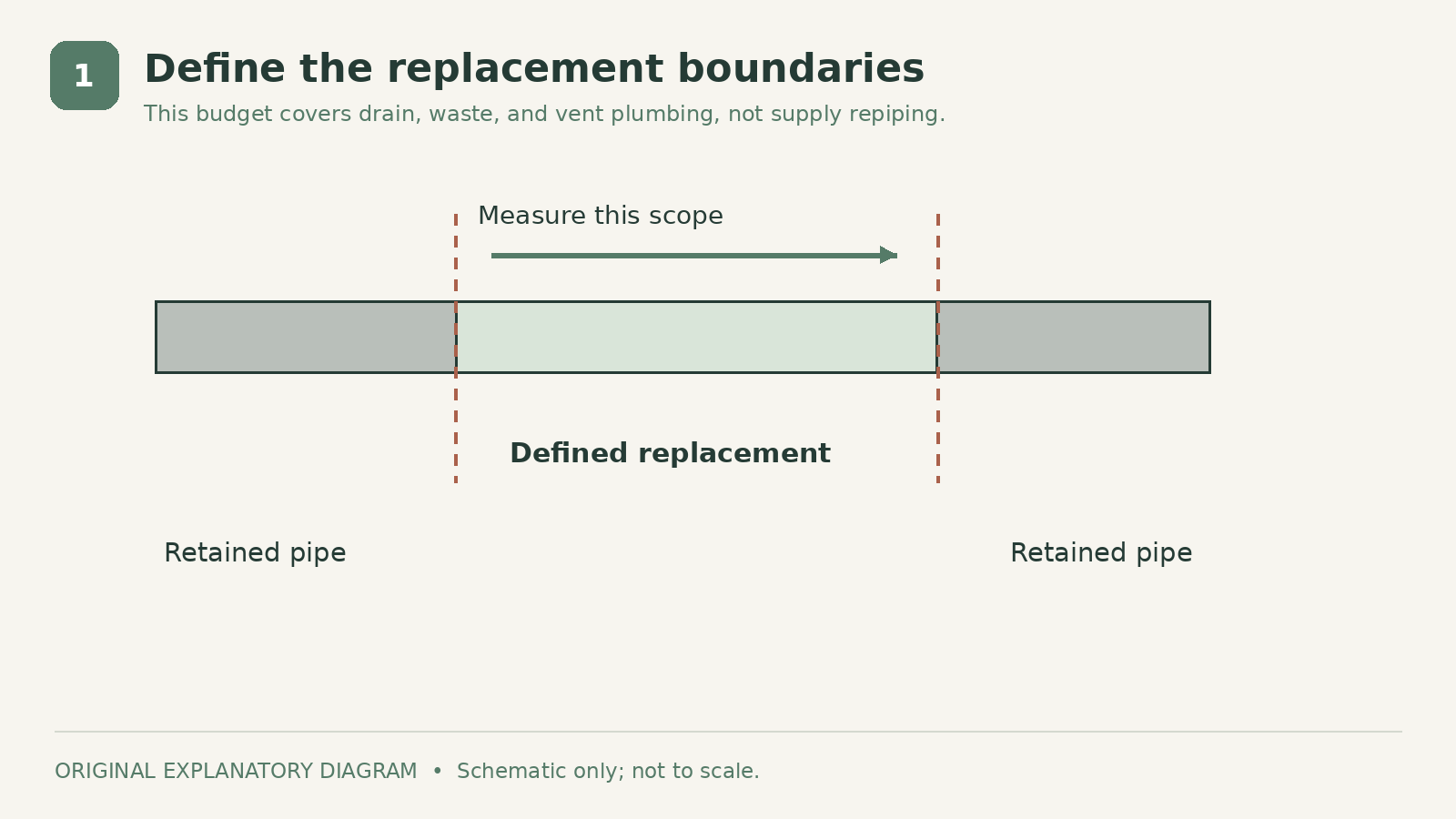
Ask the plumber to identify the starting and ending points in plain language. For example, a proposal might cover an exposed horizontal basement drain between two identified connections. Another might cover a vertical stack and several branch connections inside finished walls.
Record the approximate measured length, pipe locations, fixtures affected, and whether vent work is included. A price described only as “replace old plumbing” leaves too much room for misunderstanding.
Also ask why replacement is recommended. A visible leak, a damaged connection, repeated blockages, and a planned renovation can lead to different scopes. Where condition is uncertain, the contractor may recommend further inspection before providing a firm price.
Do not assume every remaining cast iron section must be replaced simply because one section has failed. Equally, a small patch may not be sensible if adjoining pipe is in poor condition. The condition assessment should explain that choice.
2. Separate Accessible Work From Concealed Work
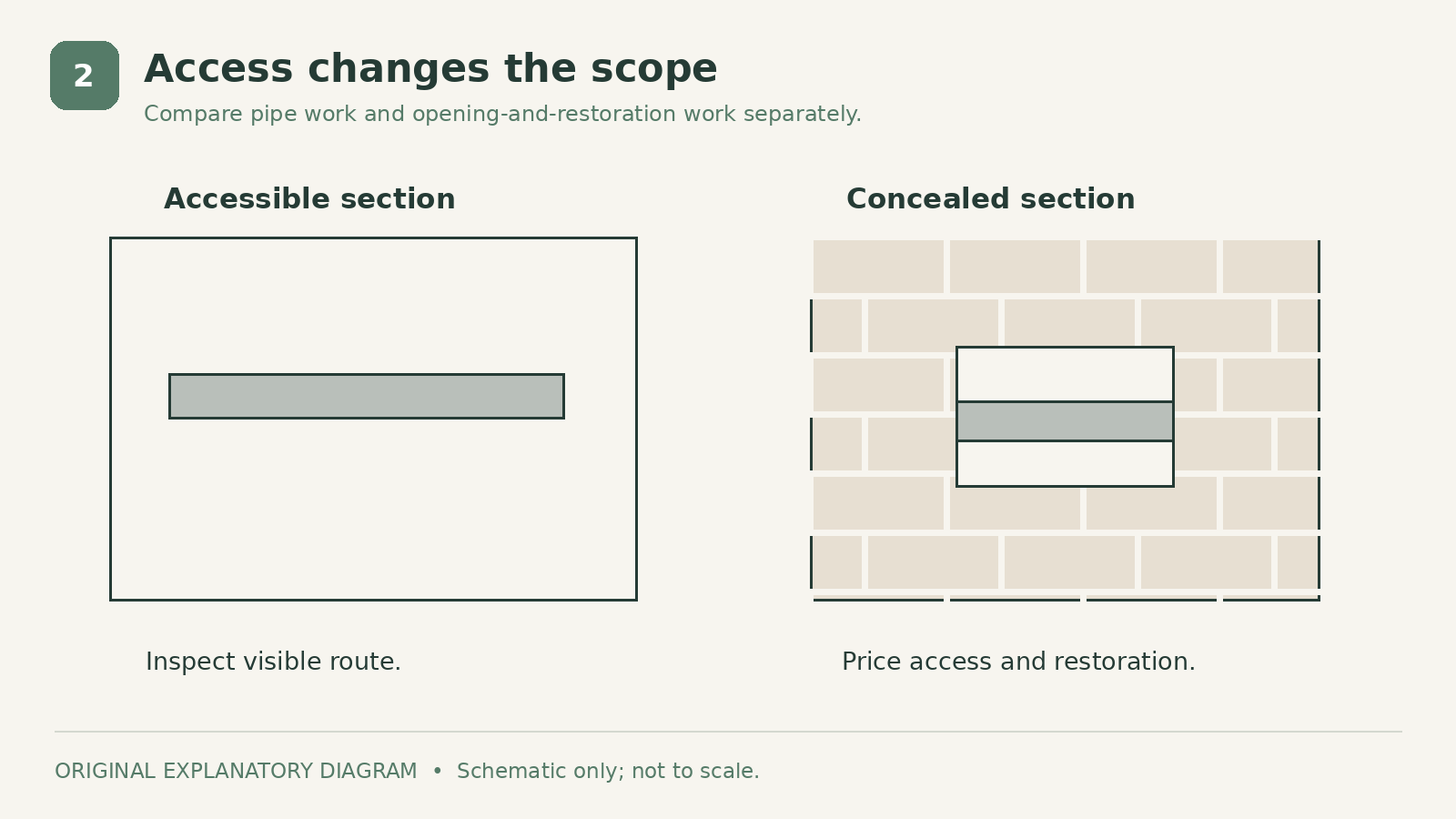
An exposed basement section generally involves a different access plan from pipe inside a tiled wall or below a slab. Ask the estimator to describe what must be opened and who will do it.
For concealed work, separate exploratory access from the final restoration allowance. The plumber may be able to estimate the pipe work while another contractor prices drywall, tile, paint, or flooring. That is workable as long as the exclusions are clear.
Photograph the visible area before the visit and note finished surfaces you want retained. Do not open suspect materials yourself just to obtain a cheaper estimate. Older buildings can introduce material hazards or construction conditions that need assessment.
If a proposal depends on an assumed route, ask what happens if that route proves inaccessible. A written change-order process is more useful than an optimistic price with no explanation of hidden conditions.
3. Specify Transitions and Related Work
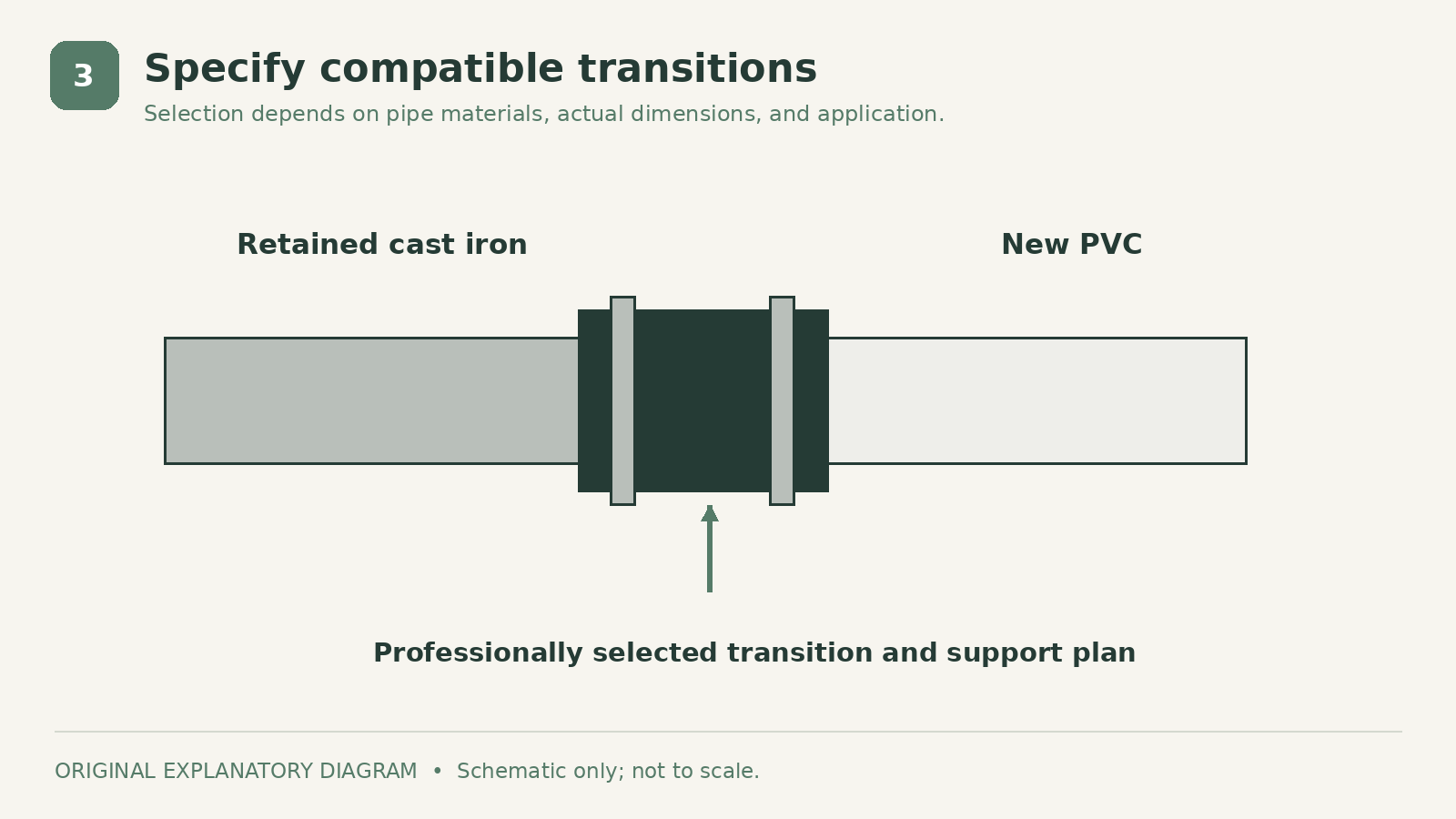
The new PVC section must connect appropriately to what remains. Fernco's ProFlex information illustrates that transition couplings are selected for particular pipe materials and applications. A generic rubber connector is not automatically suitable for every location.
Ask the contractor to identify the transition approach, the condition of the retained pipe, and any support changes included. Pipe sizing, allowable materials, venting, and installation details must meet the applicable local requirements.
Other work may include reconnecting fixtures, protecting finishes, arranging access, or coordinating inspection. Ask whether these items are included in the base price or treated as allowances.
Do not choose PVC solely because it appears less expensive as a material. Suitability depends on the building and applicable requirements. The contractor should also explain any relevant acoustic, fire-resistance, or building-management requirements for the proposed route.
4. Build a Complete Example Budget
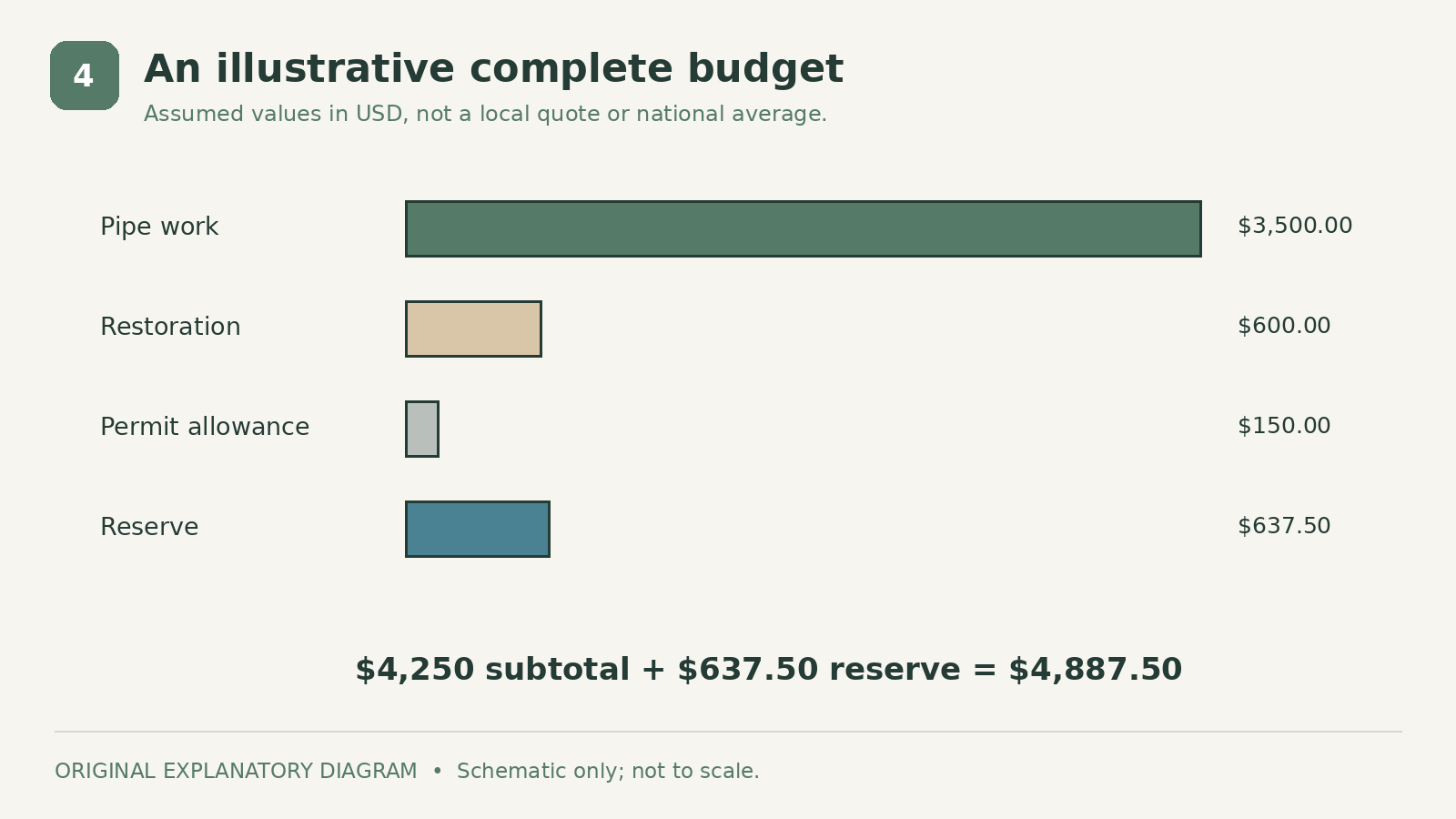
The following is an illustrative planning model, not a contractor estimate. It assumes a 20-foot replacement section at an invented all-in pipe-work rate of $175 per foot. That assumed rate includes removal, new pipe, fittings, and installation labor for this example.
| Feature | Calculation | Amount |
|---|---|---|
| Pipe replacement allowance | 20 feet × $175 | $3,500 |
| Wall and finish restoration allowance | Assumed | $600 |
| Permit and inspection allowance | Assumed, verify locally | $150 |
| Subtotal | $3,500 + $600 + $150 | $4,250 |
| Planning reserve | 15% of $4,250 | $637.50 |
| Illustrative total | $4,250 + $637.50 | $4,887.50 |
The reserve is a budgeting choice, not a required percentage or a separate contractor charge. It cannot establish the likely cost of severe hidden damage.
Avoid double counting. If a contractor's price already includes removal or permits, do not add those same items again. If restoration is excluded, obtain a separate allowance instead of assuming the plumber will repaint the room.
Use the published national benchmark only as context. Local labor, access, pipe configuration, and the actual condition can move a quote outside that range.
5. Compare Proposals and Plan the Disruption
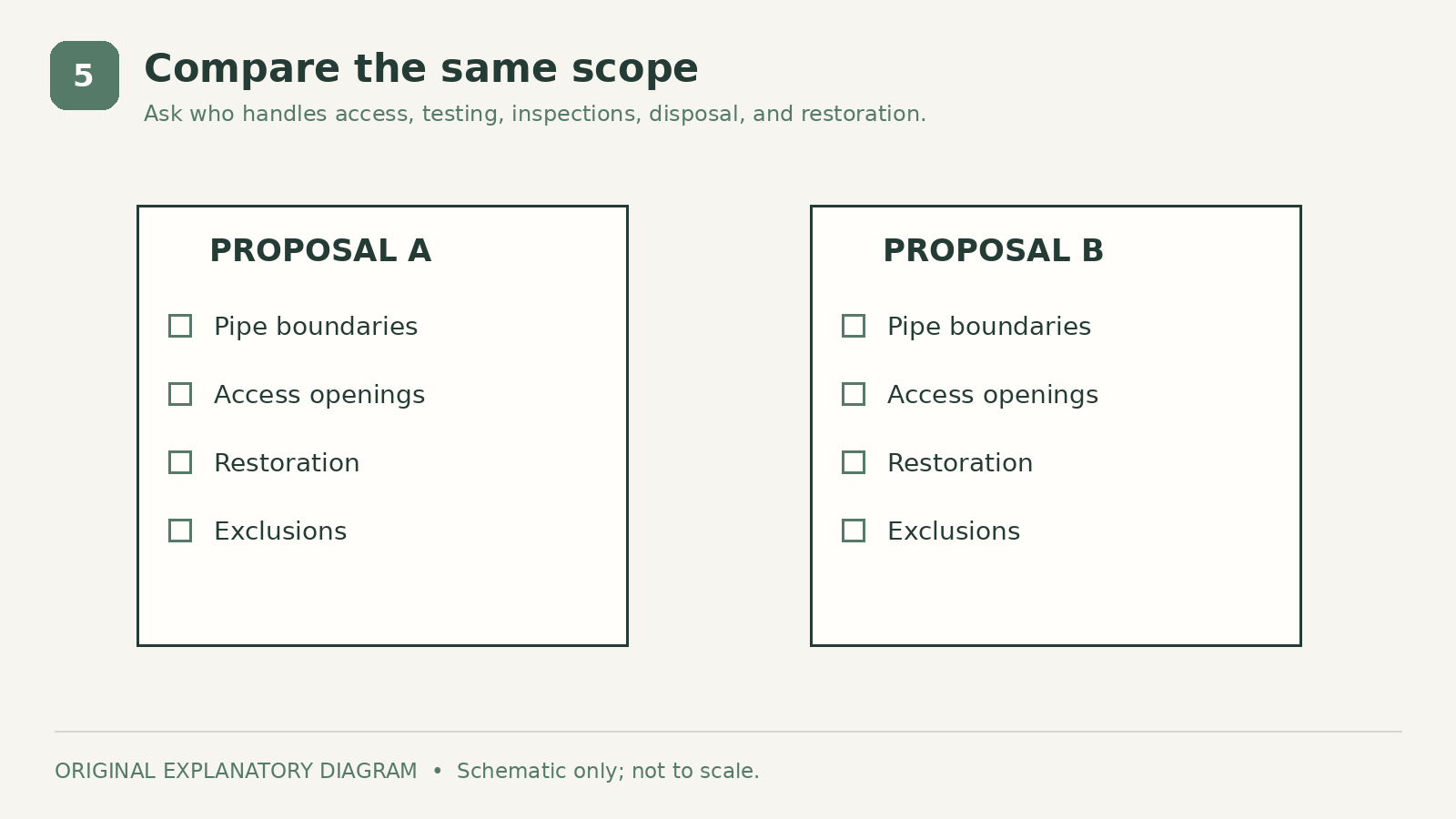
Compare proposals using the same starting and ending points. Ask each contractor to state inclusions, exclusions, expected access openings, disposal, testing, inspections, and restoration responsibility.
Confirm the contractor's required credentials through the relevant local authority and ask about insurance and warranty terms. A clear written scope is more valuable than a low headline total with unspecified allowances.
Discuss when affected fixtures will be unavailable and whether the work can be staged. A bathroom or kitchen may look untouched while its drain cannot be used. Agree on communication before work begins, especially in an occupied home or a shared building.
Document how unexpected conditions will be priced and approved. Keep the final scope, photographs, inspection records where applicable, and warranty information together for future maintenance.
Questions to Ask Before Accepting a Quote
Ask whether the price replaces only the visibly damaged section or also includes adjacent connections. Ask what inspection supports the recommendation. Confirm which surfaces will be opened and which contractor returns them to their finished condition.
If two prices differ greatly, compare access assumptions before assuming one contractor is overcharging. One may include ceiling repair or a difficult transition that the other excludes.
Ask whether the proposed work requires a permit and who obtains it. Requirements vary by jurisdiction and project, so a national article cannot settle that question for a particular address.
What Is a Sensible Starting Budget?
Start with a defined scope and a site visit, then use an itemized estimate to build your budget. The example above shows the structure of a complete allowance, not the price of a typical house.
If the scope is still unknown, spend the first effort on diagnosis and access planning. Once the route, retained pipe, and restoration responsibilities are clear, the numbers become much more useful.
Sources
- HomeGuide: Cost to Replace or Repair a Drain Pipe. Checked October 5, 2026
- Fernco: Shielded Couplings Proflex Couplings. Checked October 5, 2026
Share this article
Get new guides by email
Practical home articles and free resources. No spam, and you can unsubscribe at any time.
Keep reading

HVAC Replacement Cost in Texas: Hidden Fees to Check
Compare Texas HVAC replacement costs and hidden-fee risks, with equipment scope, duct assessment, installation allowances, and current incentive cautions.
October 2026, 4 min read

How Much Does a Lanai Screen Enclosure Cost in Florida?
Compare Florida lanai screen enclosure scopes, screen-area versus footprint pricing, frame and mesh choices, and a transparent sample budget.
October 2026, 4 min read
Stucco Repair Cost in Arizona: What Homeowners Should Know
Understand Arizona stucco repair pricing, surface damage versus concealed moisture, access, finish matching, and an illustrated repair budget.
October 2026, 5 min read