Cost Guide: Replacing a Cast Iron Sewer Line in a Basement
Budget basement cast iron sewer replacement with published cost context, access and restoration questions, and a clearly labeled under-slab example.
By Home Crane Editors. . 4 min read.
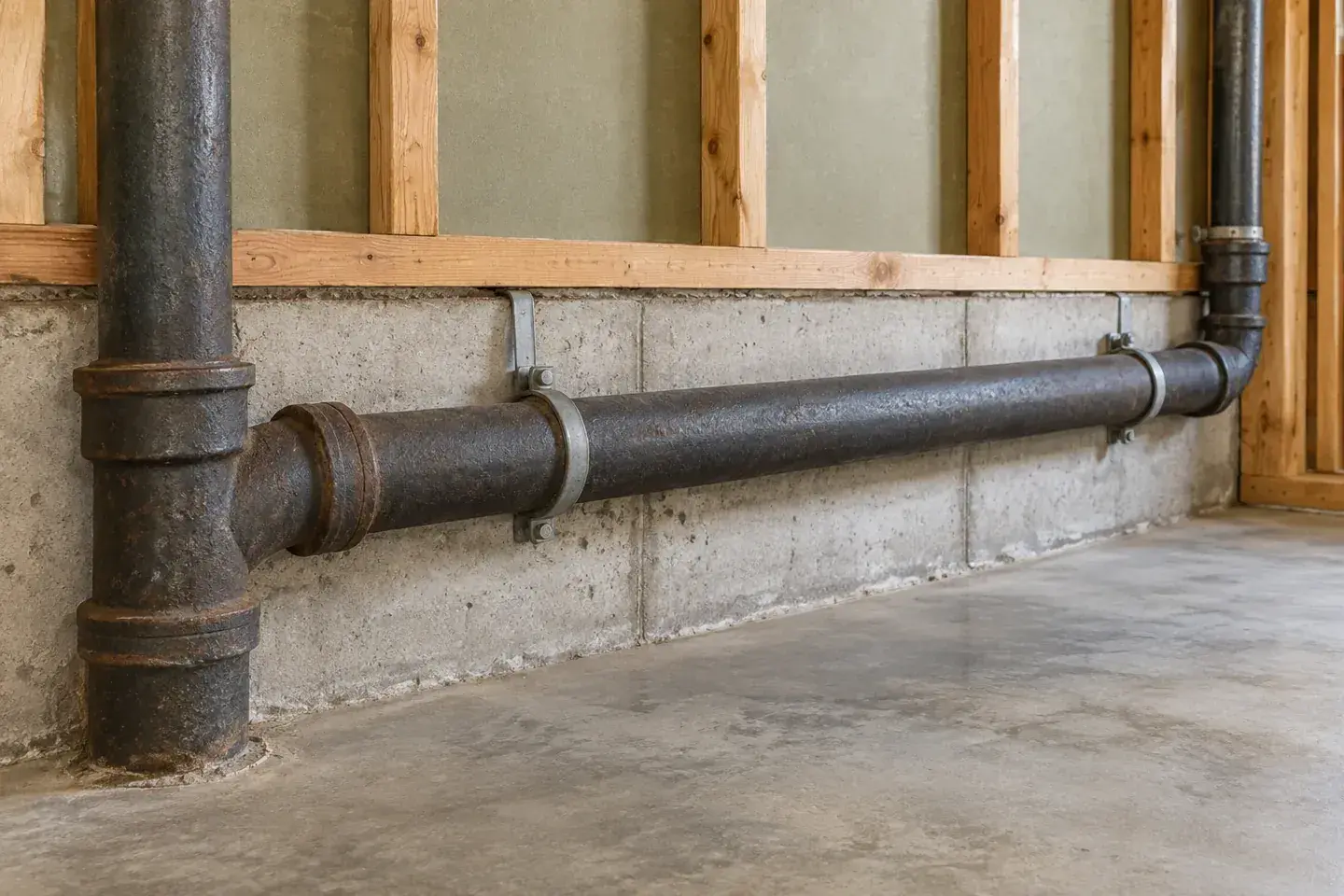
Replacing a basement cast iron sewer line can cost a few thousand dollars or become a much larger excavation and restoration project. Whether the pipe is accessible overhead or buried beneath the slab matters more than a generic price per foot. The length, branches, access, and required finish repairs determine the useful estimate.
For published context, Angi's 2026 cast iron replacement guide lists $8,000–$10,000 for a basement overhead sewer line and $3,000–$20,000 for under-slab work. These are broad guide categories, not a quote for your basement. The same page contains much lower short-run figures that should not be treated as all-in basement project prices.
A sewer replacement budget should describe a functioning, tested system and the condition in which the basement will be returned. Pipe material is only one part of that scope. Concrete cutting, excavation, support, connections, inspections, and restoration can dominate the final bill.
1. Identify the section that actually needs replacement
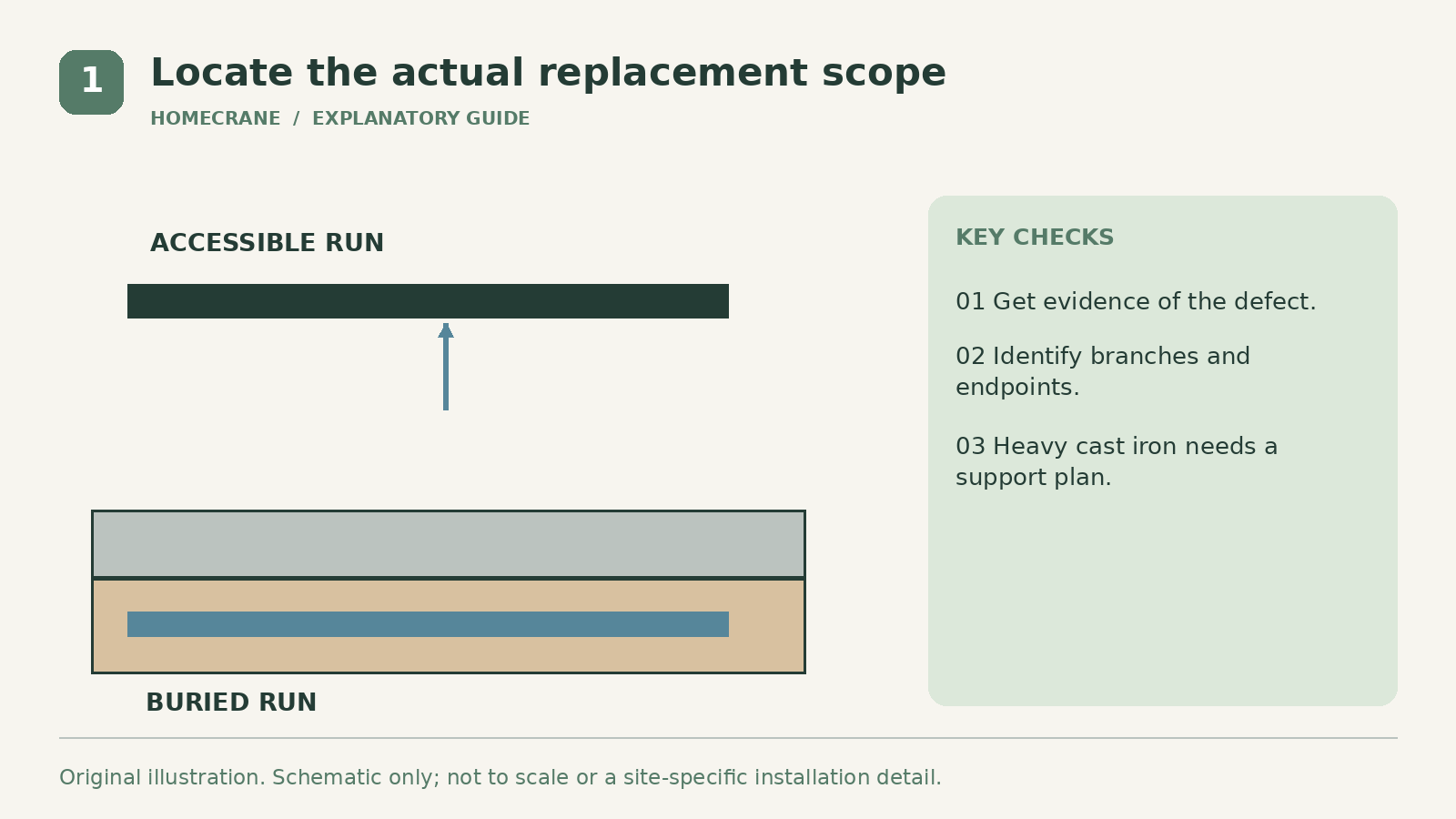
Ask the plumber to locate the failed section and explain the evidence. Visible corrosion, leakage, recurring blockage, or a camera finding may support a repair, but the entire system should not be condemned solely because it is old.
Request photographs or video where practical and a drawing showing the proposed beginning and end of replacement. Clarify whether the quote includes horizontal piping, a vertical stack, fixture branches, cleanouts, and the connection beyond the foundation.
A line below the slab is not the same as a main sewer outside the house. Make sure the proposed scope does not stop short of the known defect or charge for unrelated sections without an explanation.
Active sewage leakage requires prompt professional attention and appropriate cleanup. Avoid contact with wastewater, keep people away from contaminated areas, and limit water use as directed. This is not a project to begin by cutting into an unsupported cast iron line.
Heavy cast iron needs an appropriate support and removal plan. Ask who is responsible for supporting connected vertical sections and protecting the rest of the building while work proceeds.
2. Separate plumbing from access and restoration
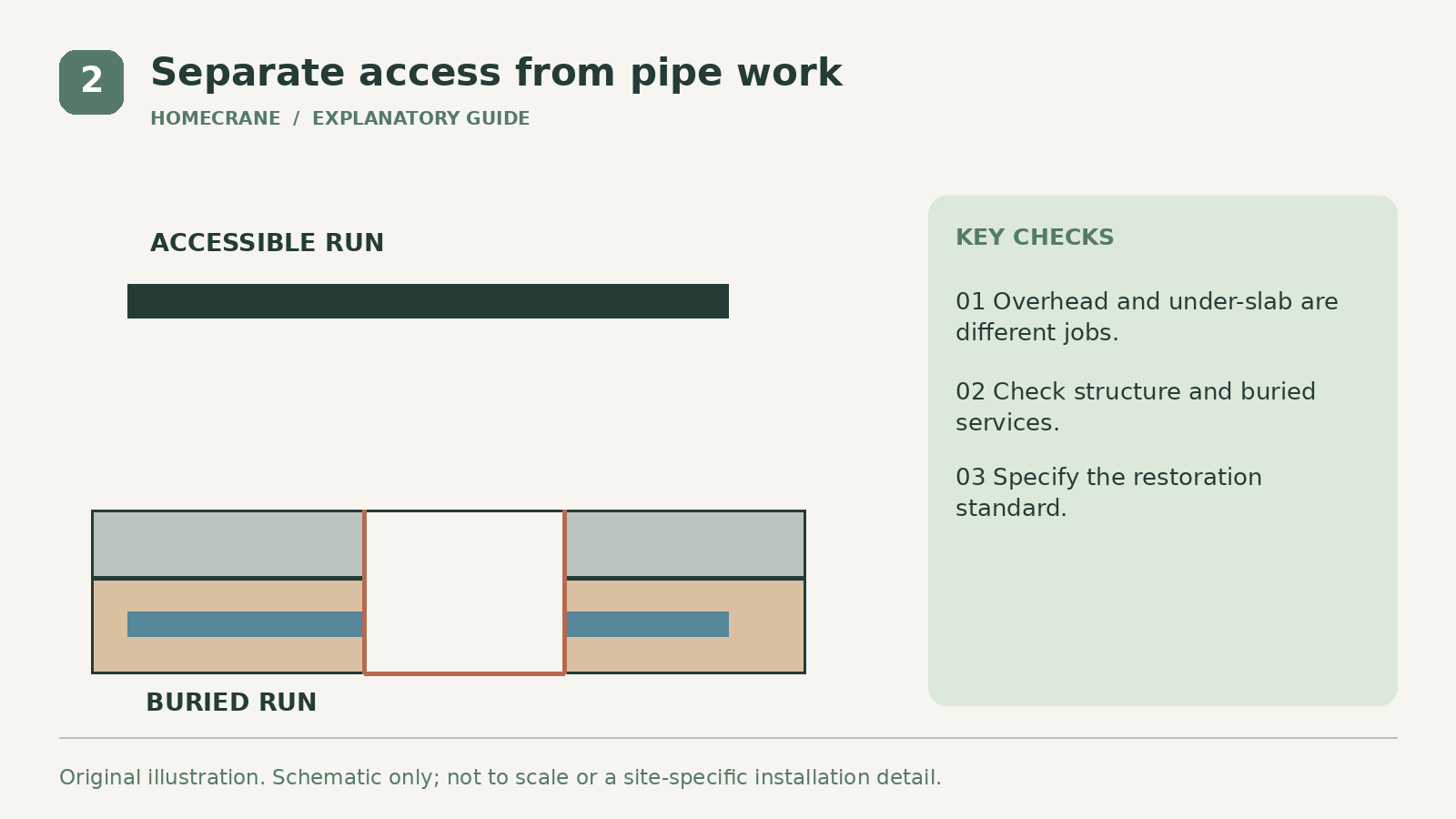
An accessible overhead run may avoid concrete work but still involve ceilings, difficult connections, and support changes. An under-slab run can require locating the route, cutting the slab, removing soil, installing the new line, testing, and restoring the opening.
Do not assume every slab can be cut wherever convenient. The contractor must account for structural conditions, reinforcement, utilities, and any special slab construction. Ask how those conditions will be checked before demolition.
| Feature | Question for the proposal | |
|---|---|---|
| Investigation | Is locating or camera work included? | |
| Demolition | Which walls, ceilings or slab areas are opened? | |
| Pipe replacement | What exact length and branches are included? | |
| Connections | How are old and new materials joined appropriately? | |
| Testing | Which inspections and tests are required? | |
| Restoration | Concrete only, or finished flooring and paint too? |
If replacing cast iron with plastic, ask which material is permitted locally and suitable for the system. Pipe sizing, slope, venting, supports, and transitions require plumbing design and code compliance. A cheaper material does not remove those responsibilities.
If noise matters, especially beneath living rooms or bedrooms, discuss it before substituting materials. The finish assembly and routing may affect how noticeable wastewater sounds become after replacement.
3. Build a transparent example budget
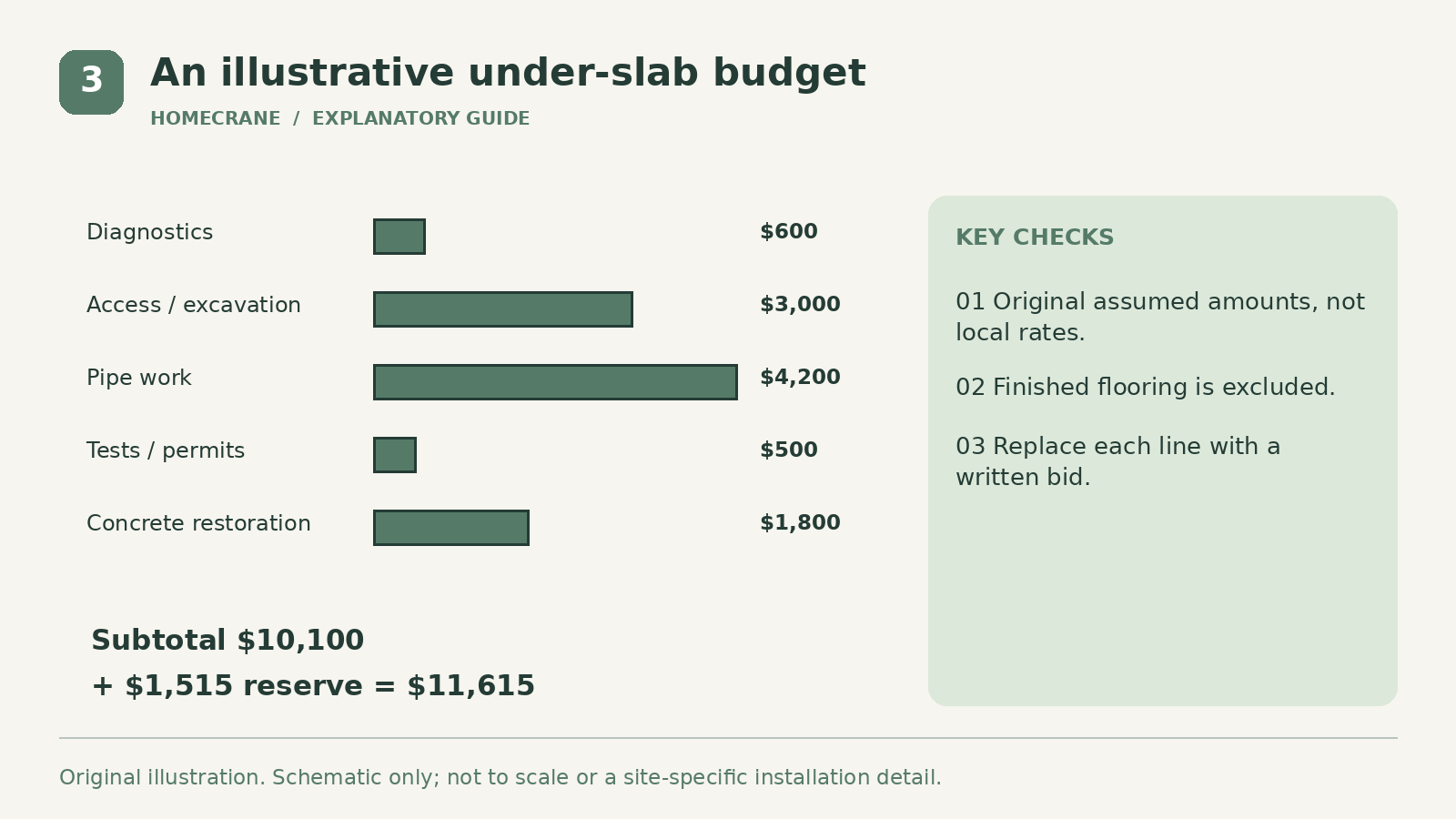
The following is an invented budgeting example for a limited under-slab project. It demonstrates accounting, not average contractor rates. Replace every amount with a written local allowance or fixed price.
| Feature | Allowance | |
|---|---|---|
| Diagnostics and route confirmation | $600 | |
| Protection, slab opening and excavation | $3,000 | |
| Pipe removal, installation and connections | $4,200 | |
| Testing and permit allowance | $500 | |
| Backfill and concrete patch | $1,800 | |
| Subtotal | $10,100 | |
| Owner contingency, 15% | $1,515 | |
| Illustrative planning total | $11,615 |
This example excludes finished flooring replacement, extensive structural repairs, exterior sewer work, hazardous-material remediation, and major sewage cleanup. If a contractor bundles several items, avoid adding them a second time.
A contingency is money reserved for uncertainty, not an unrestricted contractor fee. The contract should explain how newly discovered damage is documented and how changes are approved. Ask for unit prices only where the scope can genuinely be measured and compared.
Do not compare a quote that restores bare concrete with another that reinstalls flooring and cabinets. They may have similar plumbing work but materially different completion standards.
4. Compare replacement and rehabilitation honestly
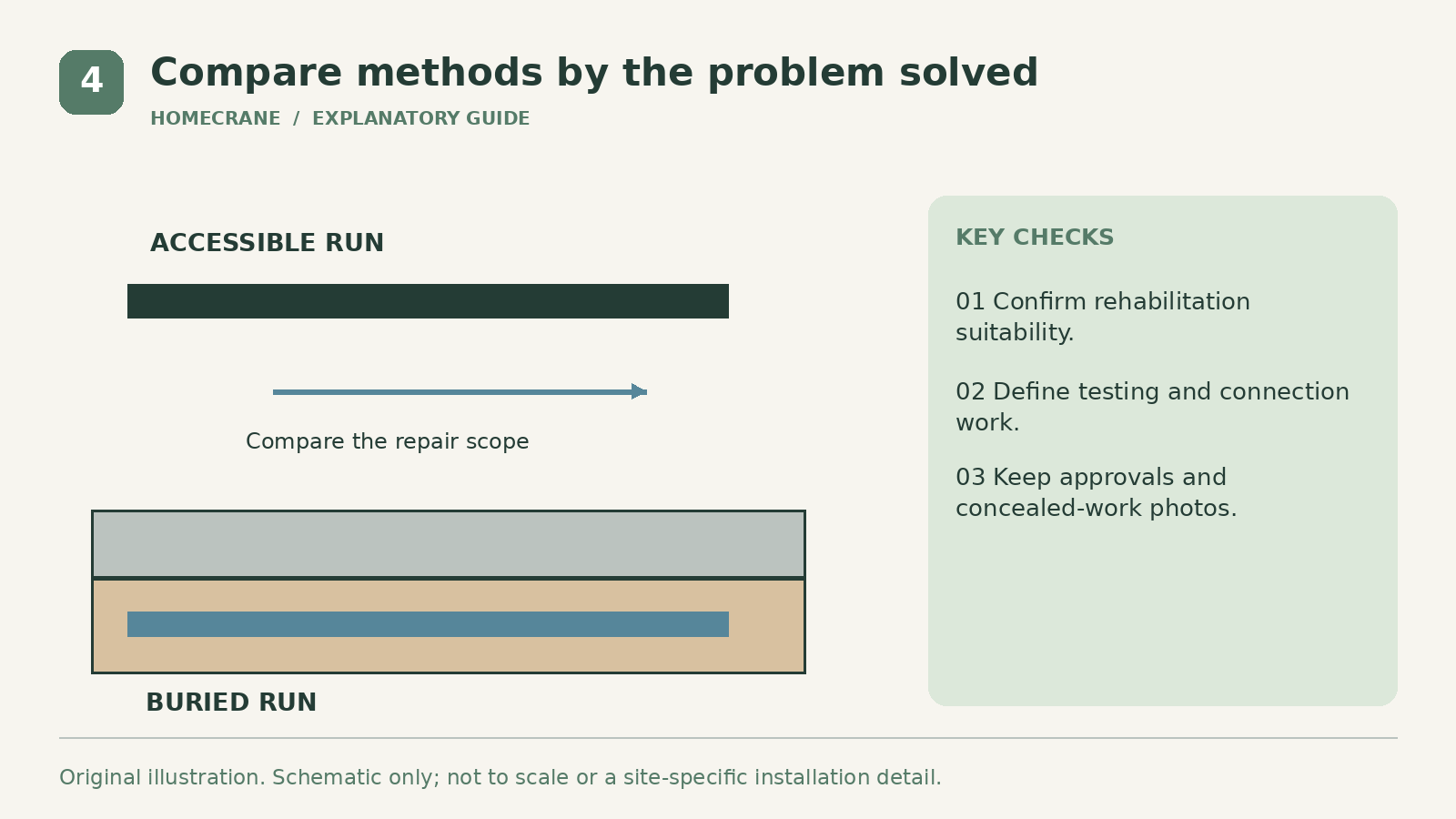
Some pipes may be candidates for a lining or other rehabilitation method, but suitability depends on condition, access, geometry, and local acceptance. Ask what defects the proposed process can and cannot correct. A treatment that does not resolve an unsuitable layout or damaged connection may not meet the actual need.
Request the product or system name, preparation requirements, inspection evidence, warranty terms, and responsibility for reinstating branch connections. Avoid choosing a method solely because the advertisement says it avoids demolition.
For open replacement, discuss how long each fixture will be unavailable and what temporary arrangements are needed. Ask about dust containment, waste handling, working hours, and access through finished areas. These details affect daily life even when they do not appear as separate line items.
At completion, obtain the inspection records, photographs before concealment, material information, and warranty documents. Keep them with the house records so future work does not rely on guessing where the new line runs.
Can I price the job by linear foot?
Only after the scope is defined. Ten feet beneath a finished slab can cost more than a longer accessible run. Use length alongside access, branches, testing, and restoration rather than as the sole predictor.
Should I replace everything at once?
Ask for the condition evidence and the cost difference between targeted and broader replacement. Coordinating adjacent work can sometimes reduce repeated demolition, but that is a project-specific decision rather than a rule based on pipe age.
Sources
- Angi's 2026 cast iron replacement guide. Checked October 11, 2026
Share this article
Get new guides by email
Practical home articles and free resources. No spam, and you can unsubscribe at any time.
Keep reading

HVAC Replacement Cost in Texas: Hidden Fees to Check
Compare Texas HVAC replacement costs and hidden-fee risks, with equipment scope, duct assessment, installation allowances, and current incentive cautions.
October 2026, 4 min read

How Much Does a Lanai Screen Enclosure Cost in Florida?
Compare Florida lanai screen enclosure scopes, screen-area versus footprint pricing, frame and mesh choices, and a transparent sample budget.
October 2026, 4 min read
Stucco Repair Cost in Arizona: What Homeowners Should Know
Understand Arizona stucco repair pricing, surface damage versus concealed moisture, access, finish matching, and an illustrated repair budget.
October 2026, 5 min read