How Much Does It Cost to Build a Backyard Greenhouse in Oregon?
Budget an Oregon backyard greenhouse with kit, base, assembly, ventilation, and approval allowances, plus a transparent 8-by-12-foot example.
By Home Crane Editors. . 5 min read.
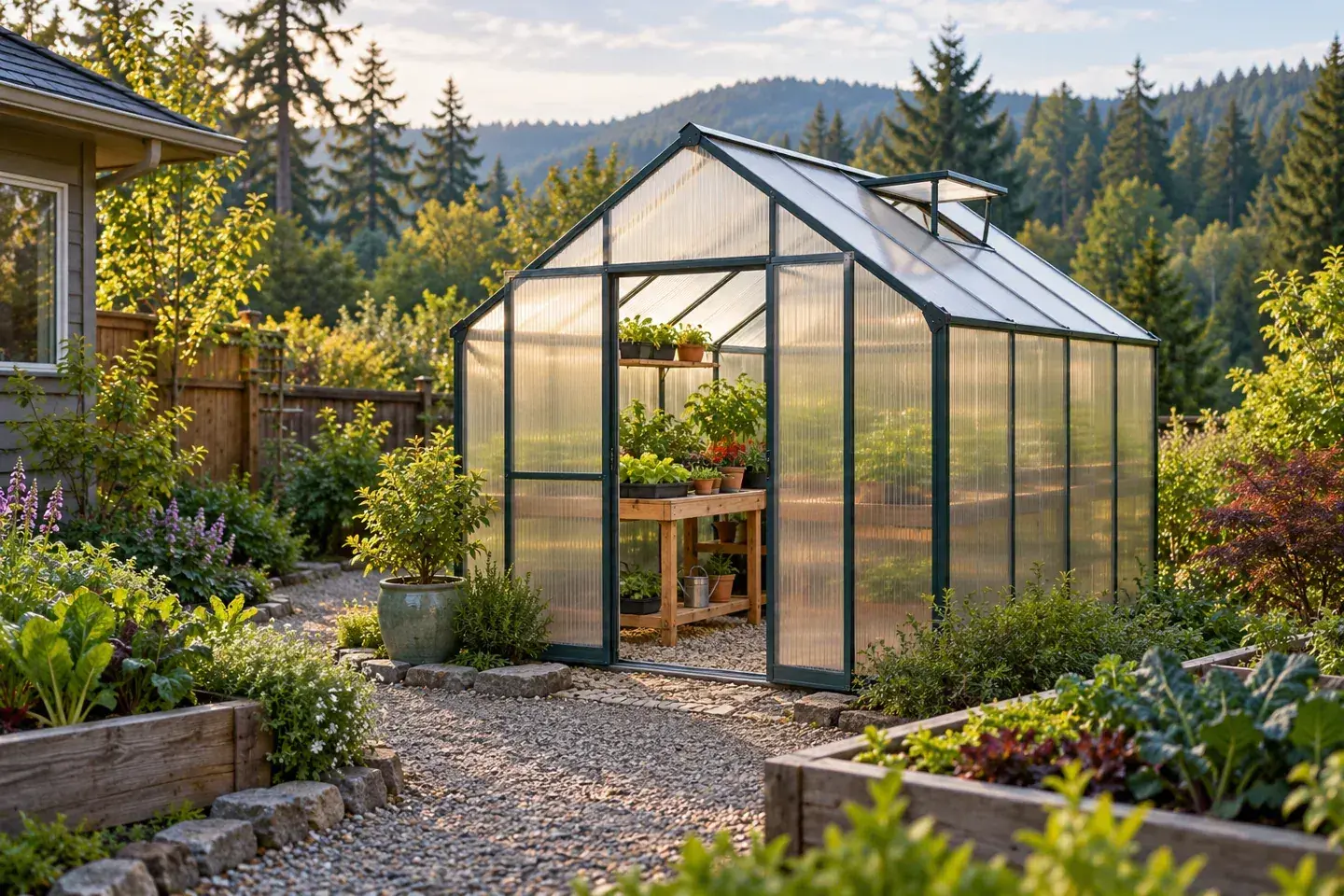
A backyard greenhouse in Oregon should be budgeted as a small building system, not just a kit. The frame and panels are only the beginning: the site, base, anchoring, assembly, ventilation, working surfaces, delivery, and local approvals can all affect the final cost.
For a concrete starting point, this guide develops an assumed $6,900 budget for an unheated 8-by-12-foot greenhouse, including a fifteen-percent reserve. That is an original planning example, not an Oregon market average or a supplier quote. Follow the steps to replace each assumption with prices for your location and growing goals.
1. Define the growing season and site
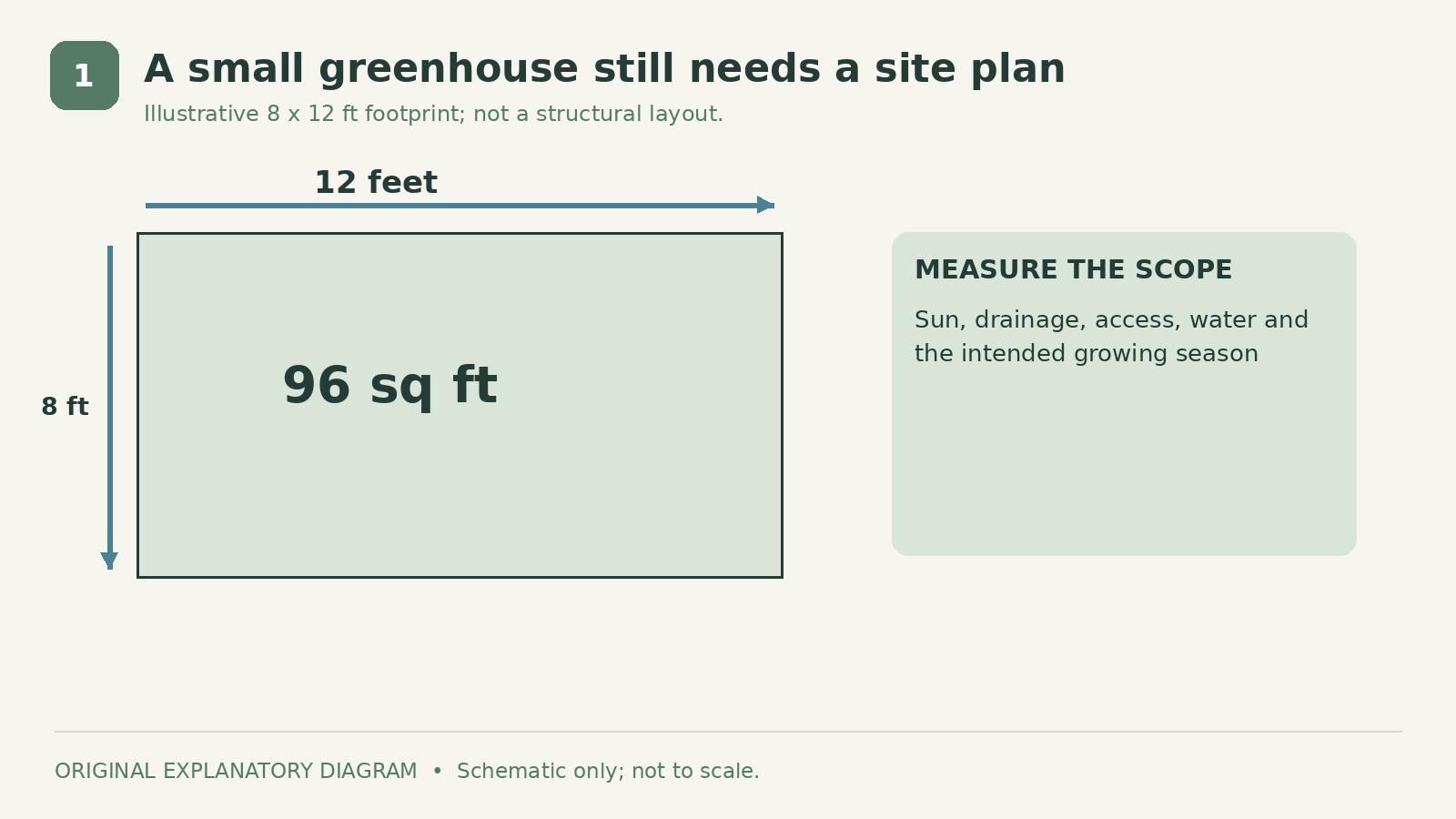
Write down what the greenhouse must do. Starting seedlings and extending the growing season is a different project from keeping tender plants warm throughout an Oregon winter. A structure without heat should not be budgeted as though it delivers year-round controlled temperatures.
Oregon State University's hobby-greenhouse design notes discuss planning issues such as site, ventilation, and environmental control. This is an older technical reference, useful for questions to investigate, not a source of current kit prices or a reason to copy an old structural plan.
Observe the proposed site at different times of day. Record sunlight, access, nearby trees, drainage, and the distance from a practical water source. Consider how you will move trays, bags of growing media, and replacement panels to the greenhouse.
Oregon locations differ sharply. A sheltered Willamette Valley yard, a windy coastal site, and a snowy inland property need different assessments. Ask the supplier to confirm the proposed model and anchoring system for your actual exposure and local design requirements.
An inexpensive kit becomes poor value if the only available location needs extensive grading or is shaded during the season when you intend to use it most.
2. Compare complete greenhouse packages
HomeGuide's national greenhouse cost guide gives a broad installed range of $5 to $30 per square foot across greenhouse types. That is national context, not an Oregon quote, and it should not be multiplied blindly by a tiny hobby greenhouse's area. Small projects can have substantial fixed costs.
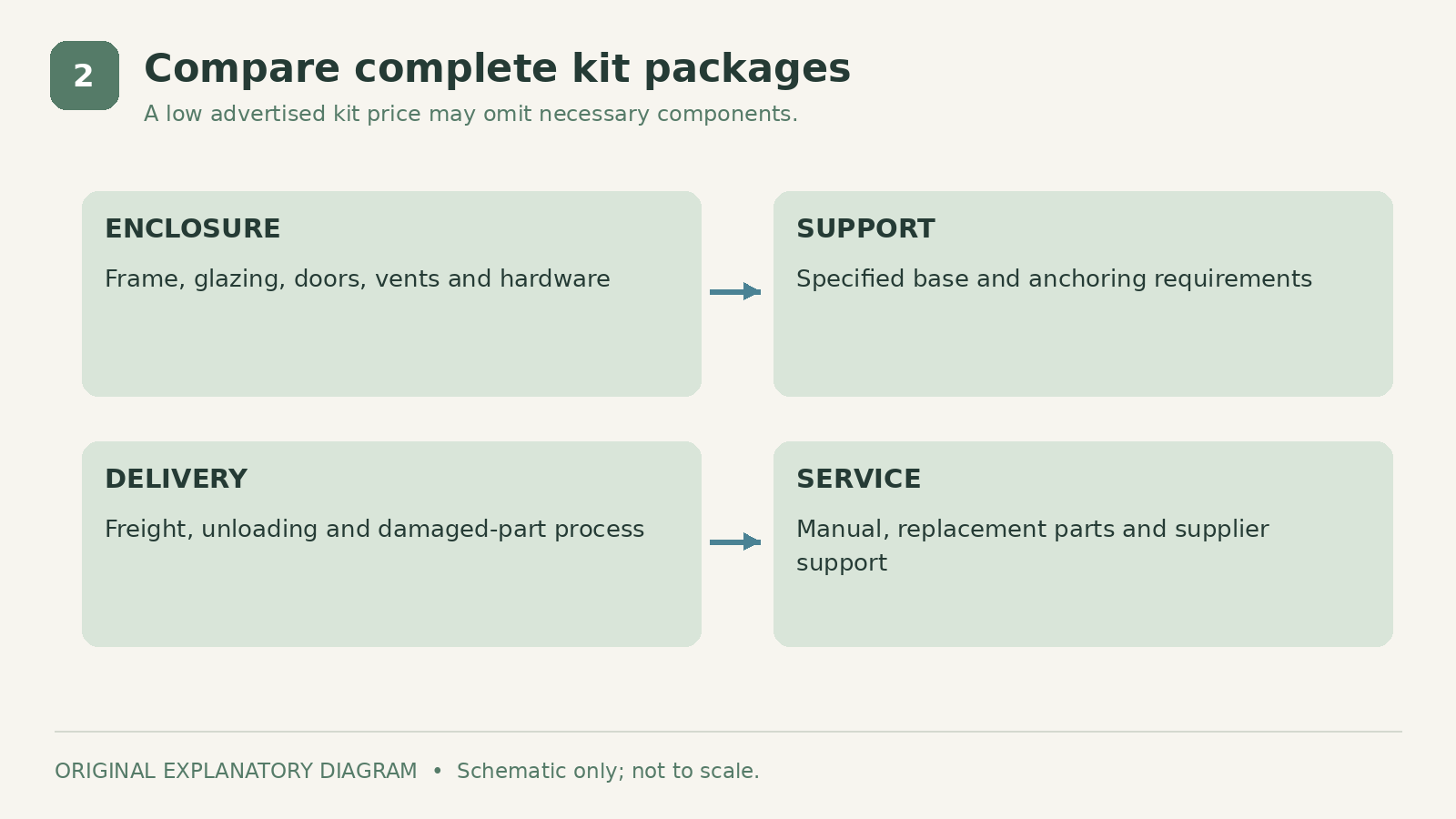
Compare packages at the same footprint and intended use. Ask what the kit includes: frame, glazing, doors, vents, hardware, base components, and anchoring. Verify whether the listed footprint is the exterior dimension and how much usable space remains after benches and circulation are planned.
Request the current assembly manual before ordering. It should help you identify required tools, helpers, foundation conditions, and any work that needs a specialist. Confirm delivery access and what happens if a panel arrives damaged.
Look beyond the purchase price to replacement parts. A broken panel or door component should have an identifiable product number and a clear ordering route. Keep the manual and invoice together.
For the sample budget, the kit allowance is $3,000 delivered. That amount is deliberately an assumption. Replace it with a complete supplier quote rather than treating it as a current advertised product price.
3. Price the base and assembly
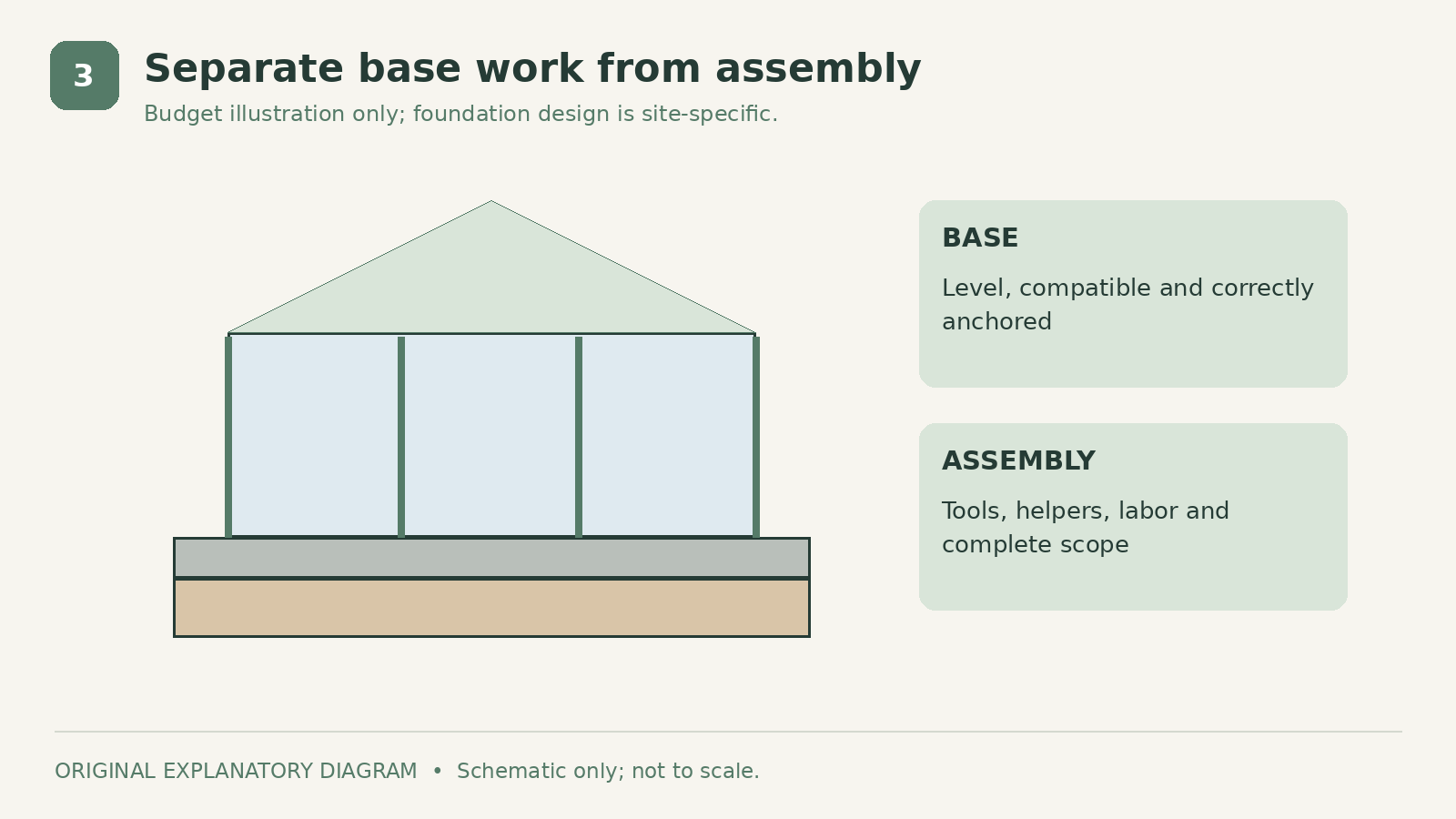
Ask for a base that meets the greenhouse manufacturer's requirements and the site's conditions. A gravel surface, perimeter base, and engineered foundation are not interchangeable just because each may appear under a greenhouse in photographs.
Separate site preparation from assembly labor in your estimate. Define who levels the site, handles excavated material, supplies the specified base, and confirms that the structure is anchored as required. If the kit supplier and installer are different businesses, settle responsibility for incompatibilities before work begins.
For this example, allow $1,000 for the site and base and $1,200 for assembly. These are placeholders for a straightforward site. They do not cover a retaining wall, difficult excavation, major drainage correction, or extensive access improvements.
If you intend to assemble the kit yourself, compare the actual savings after tool rental, delivery handling, and help are included. Do not erase the entire labor line until you understand the manual and the work involved.
Structural anchoring and wind or snow resistance deserve professional attention where required. This budgeting sequence is not a set of footing dimensions or a substitute for a design suitable for your property.
4. Add ventilation and working essentials
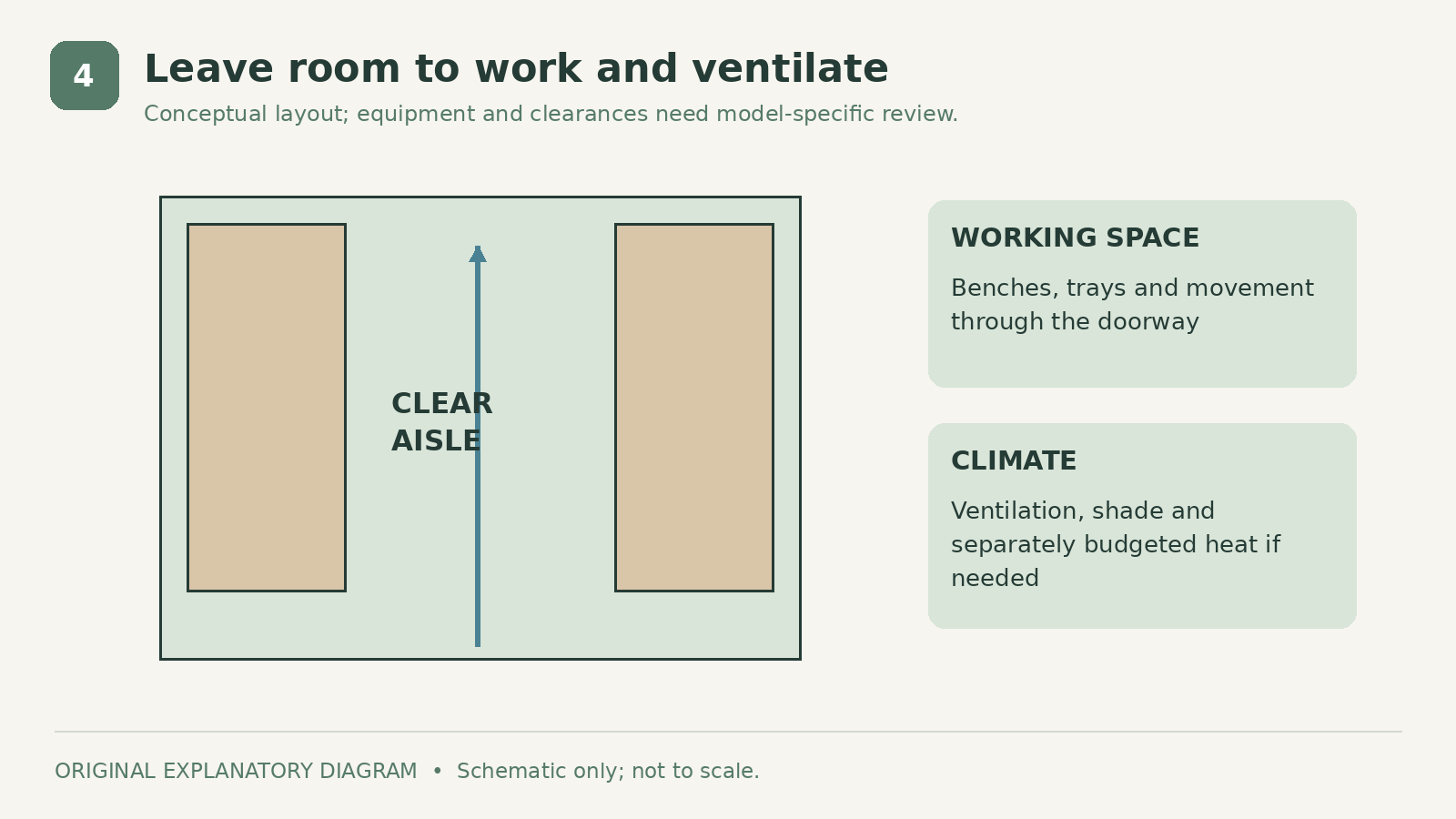
A greenhouse that fits the budget but is uncomfortable to work in can become an expensive storage shed. Sketch benches, the doorway, circulation, and your largest containers before approving the size.
Ask the supplier how the model manages ventilation and what additional controls or shading may be appropriate. Price the actual equipment instead of assuming a door left open will meet every seasonal need. For the example, ventilation and shade accessories receive a $350 allowance.
Set aside $250 for basic benches or working surfaces. Choose a layout that leaves room to move trays and reach plants without awkward lifting. Check materials and supports for the intended loads rather than reusing shelving merely because it fits the wall.
Water and electricity can change the scope substantially. A nearby existing water source is different from a new buried line. Any permanent electrical supply or heating equipment needs an appropriate design, installation, and approval process. Obtain that price separately if it is part of your goal.
Keep operating costs visible. Heating, supplemental lighting, replacement covering, and maintenance can continue long after the kit is paid for. This example excludes powered heating and a new electrical service, so it does not establish the cost of year-round growing.
5. Total the budget and check approvals
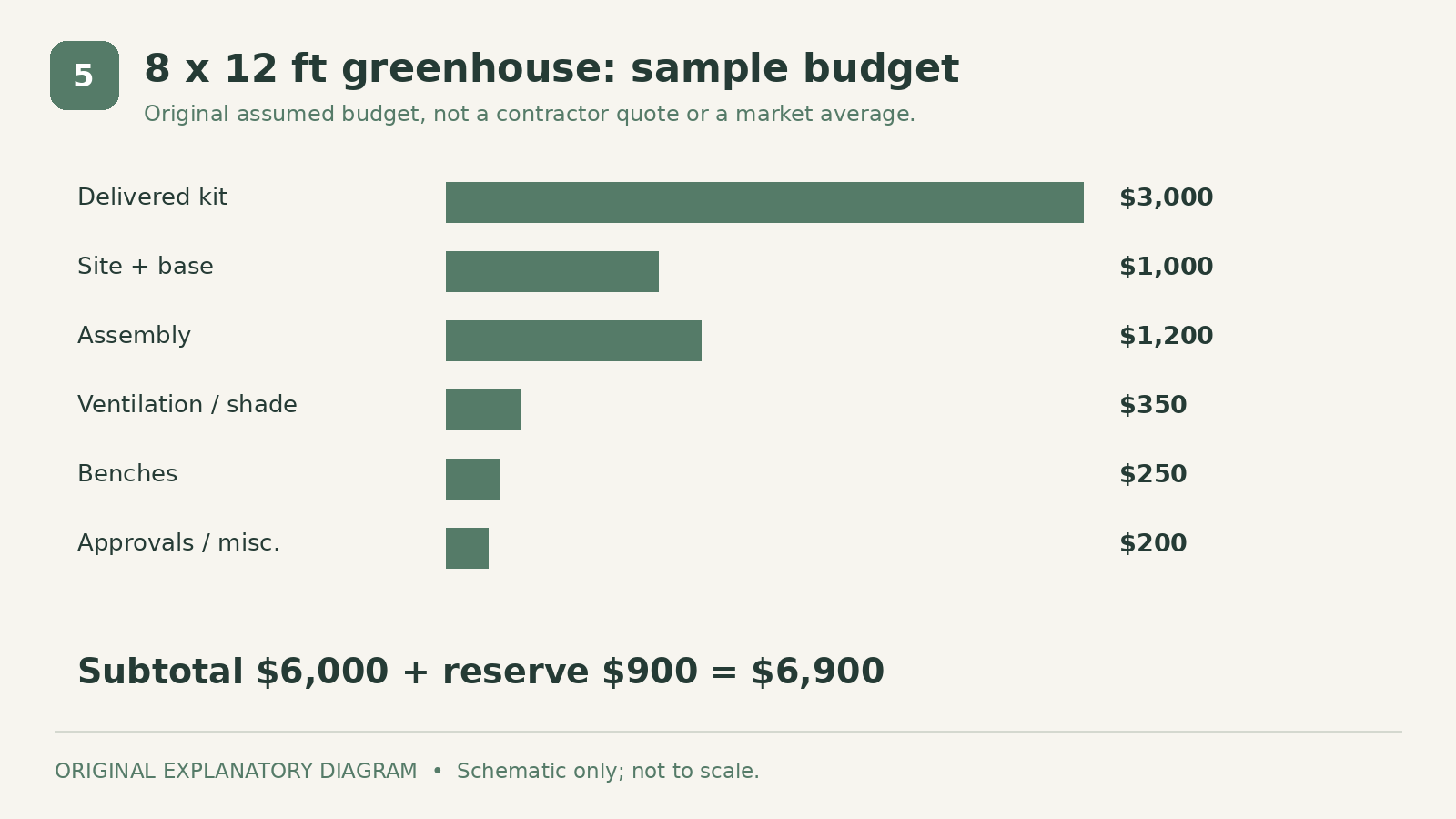
Add every necessary item before deciding whether the greenhouse is affordable. The following assumptions describe an unheated 96-square-foot hobby structure on a straightforward site.
| Feature | Assumed amount | |
|---|---|---|
| Greenhouse kit, delivered | $3,000 | |
| Site and base | $1,000 | |
| Assembly | $1,200 | |
| Ventilation and shade accessories | $350 | |
| Benches | $250 | |
| Local approvals and miscellaneous allowance | $200 | |
| Subtotal | $6,000 | |
| Owner reserve, 15% | $900 | |
| Planning total | **$6,900** |
That total is about $71.88 per square foot. It illustrates why a small, accessorized hobby project can exceed a broad national unit-cost range. The allowances are complete purchasing amounts for this exercise; major utilities, heat, unusual foundations, and financing remain excluded.
Check the exact site with your local authority before ordering. Portland's accessory-structure guidance includes greenhouses and distinguishes building-permit rules from possible zoning requirements. A small structure's building-permit exemption does not automatically remove other obligations, and Portland's guidance does not establish the rules elsewhere in Oregon.
Make the purchase decision with a complete scope
Keep the supplier quote, assembly scope, base requirements, and local guidance together. Ask for clarification wherever two documents assign the same job to someone else. Confirm the price-validity period and the process for damaged or missing parts.
If the complete total exceeds your budget, reduce accessories or size only after checking that the smaller design still serves your growing plan. The strongest cost-saving decision is often choosing a realistic season of use before buying equipment for conditions the basic structure cannot provide.
Sources
- Oregon State University's hobby-greenhouse design notes. Checked October 7, 2026
- HomeGuide's national greenhouse cost guide. Checked October 7, 2026
- Portland's accessory-structure guidance. Checked October 7, 2026
Share this article
Get new guides by email
Practical home articles and free resources. No spam, and you can unsubscribe at any time.
Keep reading
HVAC Replacement Cost in Texas: Hidden Fees to Check
Compare Texas HVAC replacement costs and hidden-fee risks, with equipment scope, duct assessment, installation allowances, and current incentive cautions.
October 2026, 4 min read
How Much Does a Lanai Screen Enclosure Cost in Florida?
Compare Florida lanai screen enclosure scopes, screen-area versus footprint pricing, frame and mesh choices, and a transparent sample budget.
October 2026, 4 min read
Stucco Repair Cost in Arizona: What Homeowners Should Know
Understand Arizona stucco repair pricing, surface damage versus concealed moisture, access, finish matching, and an illustrated repair budget.
October 2026, 5 min read