Reading a Pesticide or Fertilizer Label Before You Use It
The label on a lawn or garden product is a legal document, not a suggestion, and it contains the exact information that keeps a product from harming people, pets or nearby water. Here is how to read one.
By Home Crane Editors. . 3 min read.
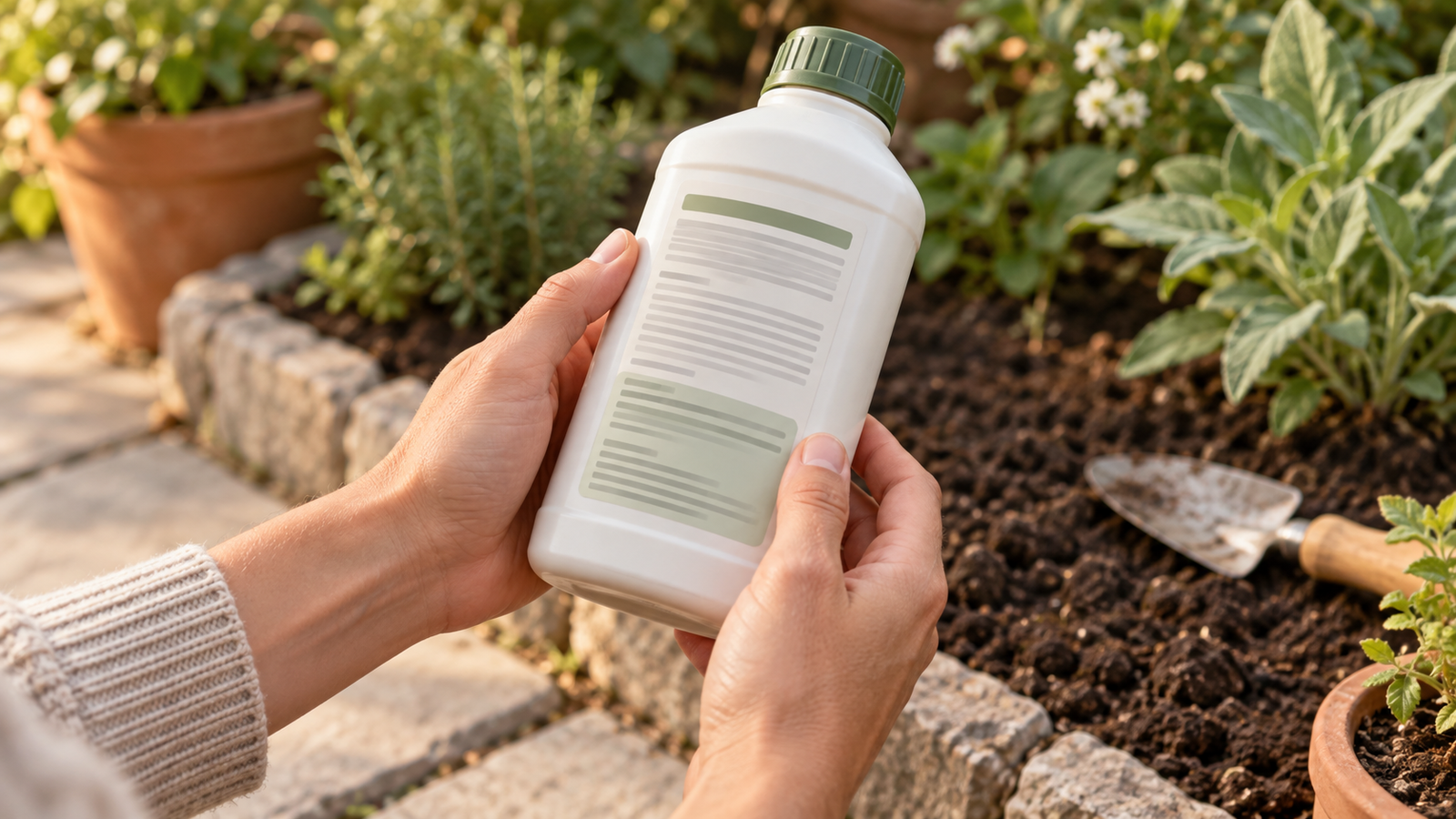
Conceptual illustration of checking a product label before application.
A pesticide label is a legal document. The Pesticide Environmental Stewardship Program, a partnership involving EPA, USDA and land grant universities, states plainly that safe and legal use of pesticides requires that the entire label be followed. Using a product in any way inconsistent with its label directions is not just poor practice, it can be a violation of federal law, which is a strong signal that the label deserves a careful read rather than a glance.
Start with the signal word
Every pesticide label carries a signal word reflecting its relative toxicity, based on EPA's classification system: Caution, Warning or Danger, in increasing order of hazard. This single word gives you an immediate sense of how carefully you need to handle the product, what protective equipment might be warranted, and how strictly to follow storage and disposal instructions.
| Feature | Relative toxicity | |
|---|---|---|
| Caution | Low toxicity, or a product in the lowest toxicity category with no signal word required | |
| Warning | Moderate toxicity | |
| Danger | High toxicity, often paired with 'Poison' and a skull-and-crossbones symbol on the most toxic products, which are typically restricted-use |
What else the label tells you
- Active ingredients. Listed by percentage, this tells you what is actually doing the work in the product, separate from inert ingredients that make up the rest of the formulation.
- Application rate. How much product to use per area, and using more than directed does not make it more effective. It increases risk to people, pets, plants and nearby water without a corresponding benefit.
- Pre-harvest interval. For products used on edible plants, university extension guidance describes this as the minimum number of days that must pass between the last application and harvest, set to allow residue levels to decline.
- Restricted-entry interval. How long people should stay off a treated area before it is safe to re-enter, sometimes with different intervals for different sites or crops.
- Storage and disposal instructions. Where and how to store the product safely, and how to dispose of any unused product and the empty container.
- Environmental hazards. Many labels specifically warn about toxicity to bees, fish or other wildlife, and about the importance of avoiding drift or runoff into waterways.
Why application rate matters so much
It is a common assumption that if a little works, more will work better or faster. Labels are calibrated based on testing for both effectiveness and safety at the stated rate, so exceeding it does not reliably improve results and does increase the risk of harming desirable plants, contaminating nearby water through runoff, or exposing people and pets to unnecessary residue. If a product does not seem to be working at the labeled rate, the more appropriate response is usually to check whether it is the right product for the specific pest or weed, or whether application timing or technique needs adjusting, rather than simply applying more.
Fertilizer labels follow a similar logic
Fertilizer products, while generally regulated somewhat differently than pesticides, carry their own important label information worth reading before use, particularly the guaranteed analysis, the three numbers representing nitrogen, phosphorus and potassium content. Applying more fertilizer than a lawn or garden needs does not simply waste product. Excess nutrients that are not taken up by plants can run off with irrigation or rainwater and contribute to water quality problems in nearby streams, ponds or groundwater, which is part of why following the labeled application rate matters for fertilizer as much as for pesticides, even though fertilizer is generally less acutely hazardous to handle.
Runoff and nearby water
Our guide to water-wise landscaping covers how water moves through a yard, and the same movement that carries irrigation runoff also carries pesticide or fertilizer residue if it is applied right before rain or irrigation, or too close to a storm drain or waterway. Check the weather forecast before applying any lawn or garden product, and follow any label guidance about buffer distances from water features.
When in doubt, ask before you apply
If a label's instructions are unclear, or you are unsure whether a product is appropriate for your specific situation, such as a yard with a vegetable garden, pets that spend significant time outdoors, or a well for drinking water nearby, your state's cooperative extension office is generally a reliable, free resource for locally relevant guidance, since land grant universities maintain these offices specifically to answer exactly this kind of question.
Your takeaway: before your next application of any lawn or garden chemical product, read the full label rather than just the front panel, and note the application rate, re-entry interval and any pre-harvest interval that applies to what you are treating.
Frequently asked questions
Is using more product than the label says ever a good idea?
No. Application rates are calibrated for both effectiveness and safety. Using more than directed increases risk without reliably improving results, and it can violate the legal terms of the product's registration.
What does 're-entry interval' mean?
It is the minimum time recommended, and on some labels required, before people or pets should walk on or enter an area after a product has been applied, allowing time for the product to settle or break down to a safer level.
Sources
- Safety Information on the Pesticide Label, Pesticide Environmental Stewardship Program (EPA, USDA and land grant university partnership). Checked September 24, 2026
- Reading a Pesticide Label (MF3071), Kansas State University Extension. Checked September 24, 2026
Share this article
Get new guides by email
Practical home articles and free resources. No spam, and you can unsubscribe at any time.
Keep reading
8 Best Aesthetic Indoor Herb Garden Planters To Buy
Shop stylish indoor herb garden planters, from ceramic pots and self-watering herb keepers to windowsill troughs and countertop gardens with grow lights.
November 2026, 11 min read
10 DIY Terracotta Clay Pot Tower Garden Ideas
Discover 10 DIY terracotta clay pot tower garden ideas, with practical planting, drainage, stability, and care tips for patios, balconies, and small gardens.
November 2026, 9 min read