Wallpaper Hanging Service Cost: What to Expect in the US
Understand US wallpaper hanging costs, labor versus materials, wall preparation, and quote comparisons, with a clearly labeled sample accent-wall budget.
By Home Crane Editors. . 5 min read.

Wallpaper hanging service cost depends on the wall area, material, pattern, and preparation involved. As a US budgeting reference checked October 5, 2026, Angi reports labor of $1 to $4 per square foot or $30 to $80 per hour. These are published estimates, not a quote for your home. Ask whether materials, preparation, removal, and a minimum job charge are included before comparing prices.
The most useful budget separates the paper from the work needed to put it on the wall. A simple-looking accent wall can still require careful preparation or expensive pattern matching. A larger straightforward room may be easier to price per square foot.
Understand What the Price Covers
Ask each installer to describe the same scope. A labor-only estimate might cover hanging the supplied wallpaper on a ready surface. Another proposal may include primer, adhesive, minor repairs, and cleanup. The lower headline number is not necessarily the lower completed-project cost.
Keep these categories distinct when discussing the job:
| Feature | What to confirm | |
|---|---|---|
| Wallpaper | Product, roll size, quantity, freight, and tax | |
| Preparation | Removal, wall repairs, smoothing, primer, and drying time | |
| Hanging labor | Measured area, pattern complexity, and minimum charge | |
| Access and protection | Furniture movement, floor protection, and high areas | |
| Completion | Cleanup, disposal, inspection, and spare material |
Angi also publishes a combined materials-and-labor range of $3 to $8 per square foot. Use that only as a broad reference. Do not add its labor-only range to that combined figure, since doing so would count labor twice. Its room examples do not define your actual wall area or chosen paper.
Measure the Walls, Not the Floor
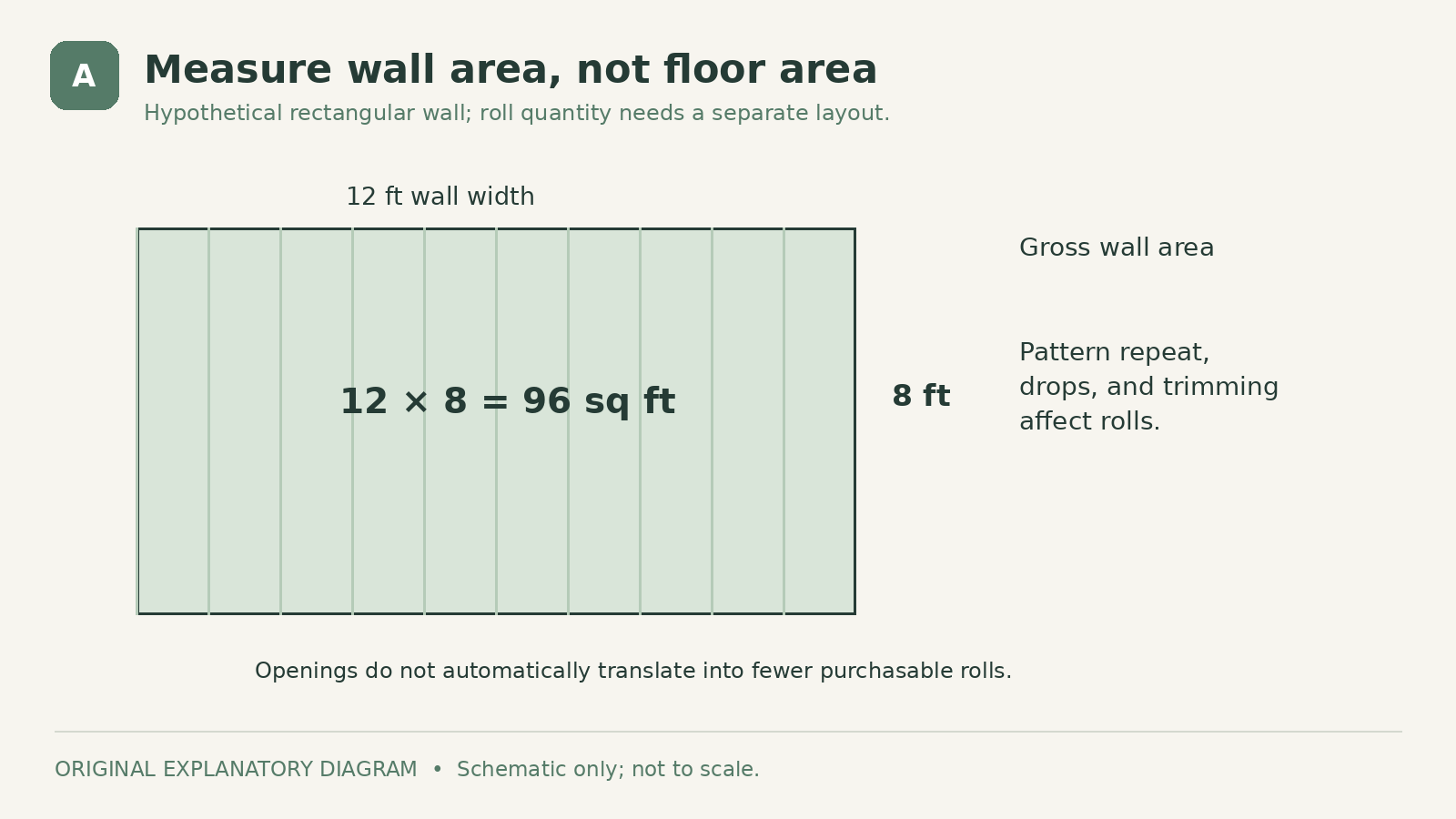
A room's floor area is not its wallpaper area. For a rectangular wall, multiply width by height. Add the areas of the walls you intend to cover, and send the installer photographs showing windows, doors, corners, and fixtures.
For example, a hypothetical wall 12 feet wide and 8 feet high has 96 square feet of gross wall area. That gives the installer a starting measurement. It does not establish the roll quantity or final bill.
The Wallcovering Installers Association's estimating guidance starts with wall dimensions and recommends professional estimates for unusual spaces. Do not deduct every opening and assume the remaining area translates directly into purchasable rolls. The installer must still plan complete drops, trimming, and the pattern repeat.
Send the exact product link before ordering. Rolls differ in dimensions and usable coverage, and a description such as “double roll” needs to be read alongside the manufacturer's measurements. Ask the installer to approve the quantity in writing.
Why Wall Condition Changes the Quote
Wallpaper will sit on the existing surface, so its condition deserves attention before anyone prices the hanging work. Tell the installer about peeling paint, patched areas, texture, old wallpaper, or previous moisture problems.
ROMAN's wall-preparation guidance emphasizes preparing a suitable surface and following product instructions. Ask which primer and adhesive are compatible with your particular paper and wall, rather than assuming ordinary paint primer is interchangeable with every wallcovering system.
Request a separate allowance for uncertain repairs. An installer who cannot see behind old paper may reasonably price removal first and confirm additional work afterward. Agree on how changes will be documented before the job begins.
Resolve active moisture problems before covering a wall. If preparation may disturb older paint or unknown materials, ask the contractor how the work will be assessed and handled. This cost guide is not a wall-stripping or hazardous-material removal tutorial.
Pattern and Material Affect the Work
A plain wallcovering and a large repeating print can create very different layouts. Corners, window returns, ceiling lines, and the desired position of a focal motif all influence how the installer plans the first strip and subsequent joins.
Discuss the appearance you expect before accepting a quote. For a mural, identify where the central image should sit relative to furniture. For a textured natural wallcovering, ask what seam visibility and color variation are normal for that product.
Do not assume peel-and-stick paper eliminates preparation or installation skill. Ask for the manufacturer's surface requirements and whether your installer works with that material. A service provider may have different terms for customer-supplied products, including responsibility for defects or insufficient quantities.
Order samples when possible. View them in the room's actual light, including evening lighting, and decide whether the surface texture and finish justify the total installed cost.
A Hypothetical Accent-Wall Budget
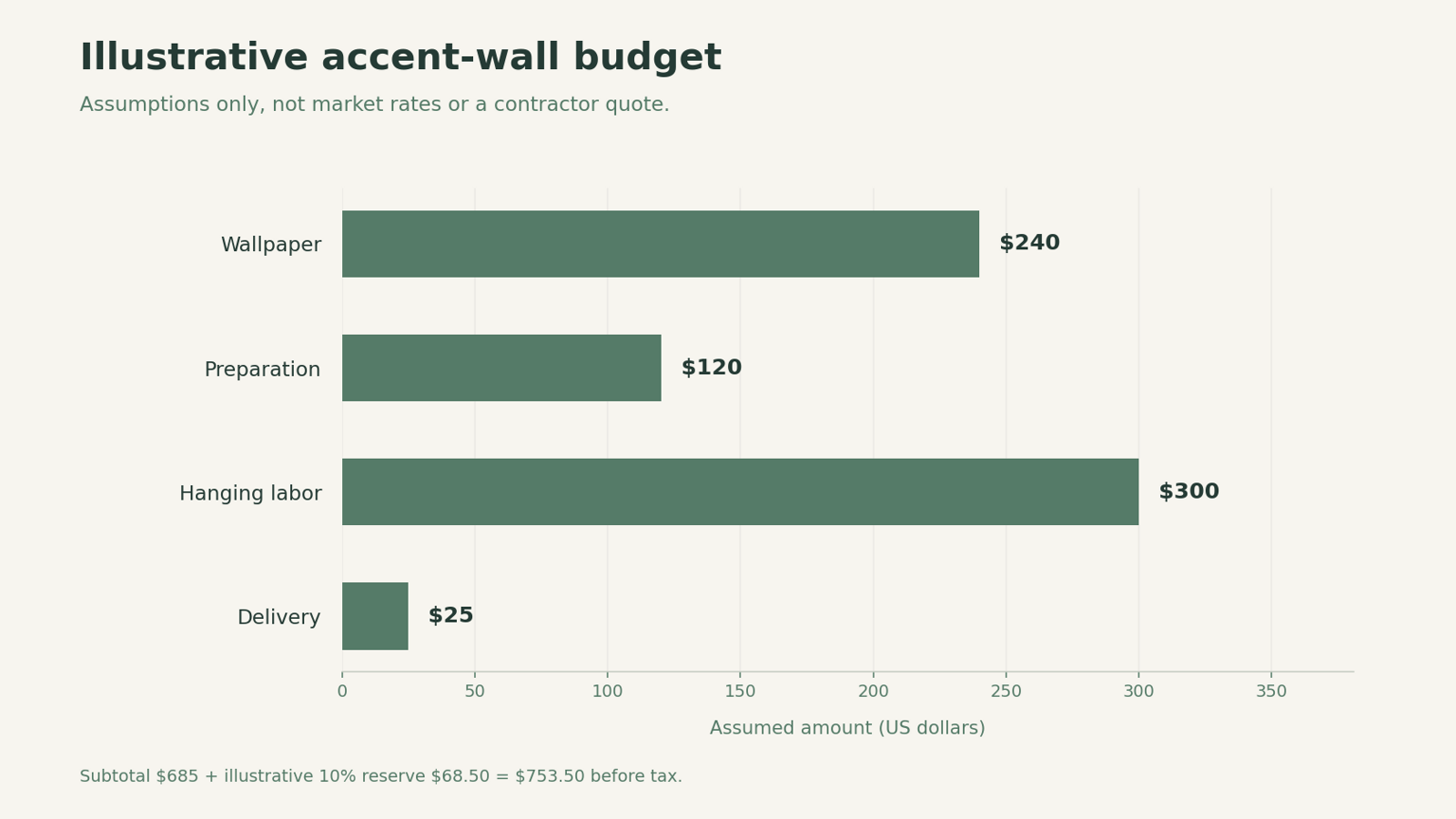
The following example demonstrates how to organize a quote. Every dollar amount is an assumption, not a local rate, contractor offer, or national average. Assume the installer has already confirmed the paper quantity.
| Feature | Assumed amount | |
|---|---|---|
| Approved wallpaper quantity | $240 | |
| Preparation and primer | $120 | |
| Hanging labor, including minimum charge | $300 | |
| Delivery | $25 | |
| Subtotal before tax and any changes | $685 | |
| Illustrative reserve, 10% of subtotal | $68.50 | |
| Planning total before tax | $753.50 |
The calculation is $240 + $120 + $300 + $25 = $685, followed by $685 × 10% = $68.50. The reserve is money held aside, not automatically a charge on the invoice. A different condition or product could change any of these assumptions.
A small project may be governed by a minimum fee rather than the wall area multiplied by an advertised rate. Ask the installer to show which pricing method applies to your job so you can avoid an unrealistically low estimate.
How to Compare Installer Proposals
Give installers the same photographs, dimensions, product details, and preferred scope. Ask for preparation, hanging, materials, and exclusions to be identifiable even when the final price is a lump sum.
Clarify who orders the wallpaper, checks the shipment, and confirms that enough matching material is available. Ask what happens if a defect is found after the first few strips or if additional paper is needed. Agree on approval before substitutions.
Request examples of work involving a similar material and pattern. A general painting portfolio does not show how an installer handles your particular wallcovering. Discuss the expected treatment of seams, corners, outlets, and the starting point of the pattern.
Confirm the proposed schedule, deposit terms, change-order process, and cleanup responsibilities. Avoid paying for an undefined promise such as “complete installation” without a shared understanding of what completion includes.
Where to Save Without Sacrificing the Finishing
Reducing the covered area is often the clearest way to control a wallpaper project. One carefully chosen wall can deliver the look you want while keeping the remaining walls painted. Compare the full installed cost of two shortlisted papers before committing to either.
You may also be able to move small furniture and clear the room yourself if the installer agrees. Confirm whether doing so actually changes the quoted price. Do not undertake unfamiliar wall repairs just to remove a preparation line from the estimate.
The next useful step is a measured brief: photographs, wall dimensions, exact wallpaper, known surface issues, and the finish you expect. That makes a local quote far more dependable than a generic “cost per room” figure.
Sources
- Angi reports labor of $1 to $4 per square foot or $30 to $80 per hour. Checked October 5, 2026
- Wallcovering Installers Association's estimating guidance. Checked October 5, 2026
- ROMAN's wall-preparation guidance. Checked October 5, 2026
Share this article
Get new guides by email
Practical home articles and free resources. No spam, and you can unsubscribe at any time.
Keep reading
HVAC Replacement Cost in Texas: Hidden Fees to Check
Compare Texas HVAC replacement costs and hidden-fee risks, with equipment scope, duct assessment, installation allowances, and current incentive cautions.
October 2026, 4 min read
How Much Does a Lanai Screen Enclosure Cost in Florida?
Compare Florida lanai screen enclosure scopes, screen-area versus footprint pricing, frame and mesh choices, and a transparent sample budget.
October 2026, 4 min read
Stucco Repair Cost in Arizona: What Homeowners Should Know
Understand Arizona stucco repair pricing, surface damage versus concealed moisture, access, finish matching, and an illustrated repair budget.
October 2026, 5 min read