Water Softener Installation Cost in Indiana: Is It Necessary?
Understand Indiana water softener costs, local hardness data, equipment choices, installation scope, and how to decide whether treatment is worthwhile.
By Home Crane Editors. . 4 min read.
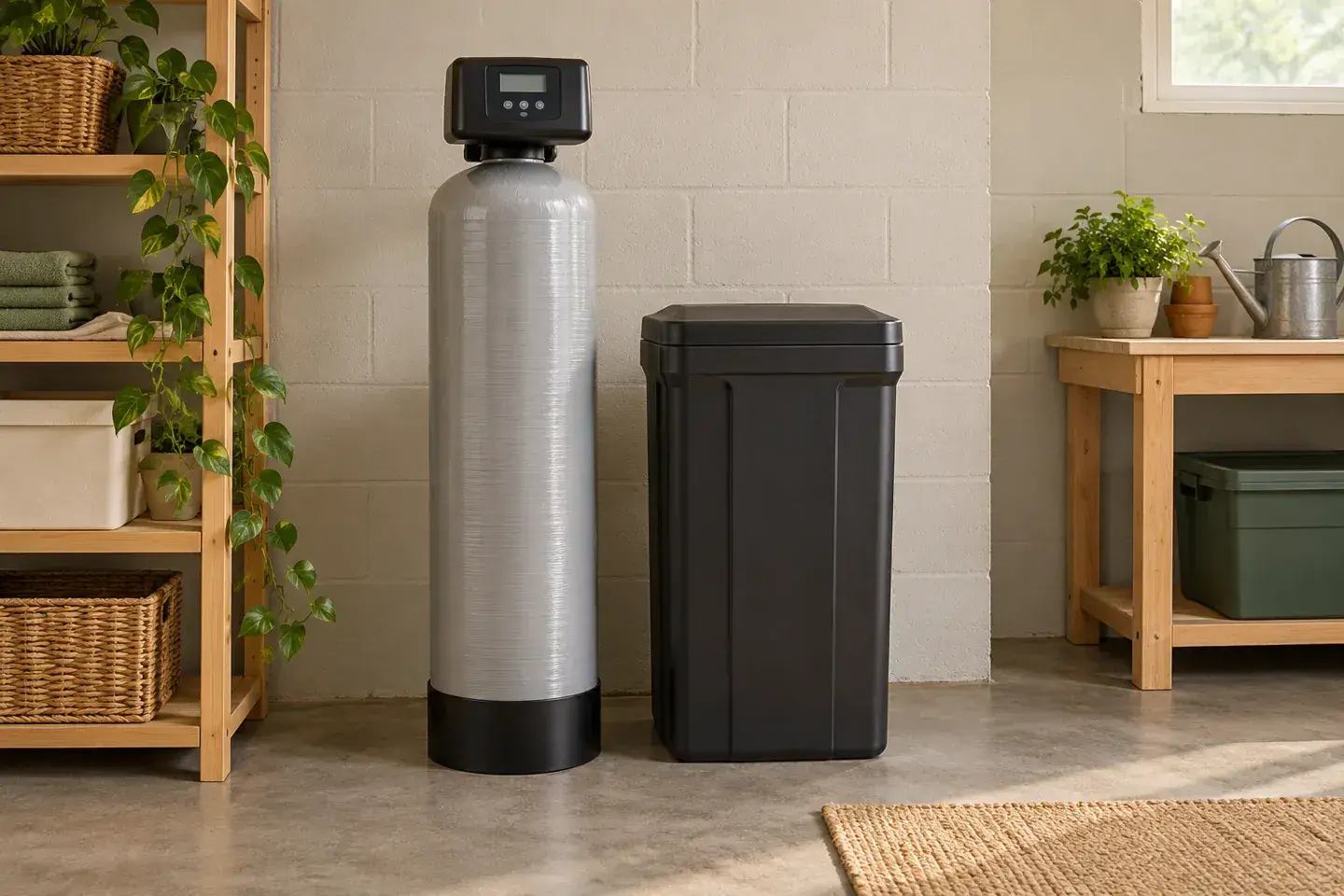
A water softener is worth evaluating when measured hardness is causing persistent scale, difficult cleaning, or other problems you want to reduce. It is not automatically necessary because you live in Indiana. Your water source, actual test results, household use, and willingness to maintain equipment should drive the decision.
For price context, Angi's Indianapolis guide reports a modeled installation average of about $1,436, with an unusually broad $191-to-$5,742 range. That mixes different project scopes and is not a reliable quote for a complete new ion-exchange system. A more useful approach is to price the selected equipment and the work needed at your home separately.
1. Find out how hard your actual water is
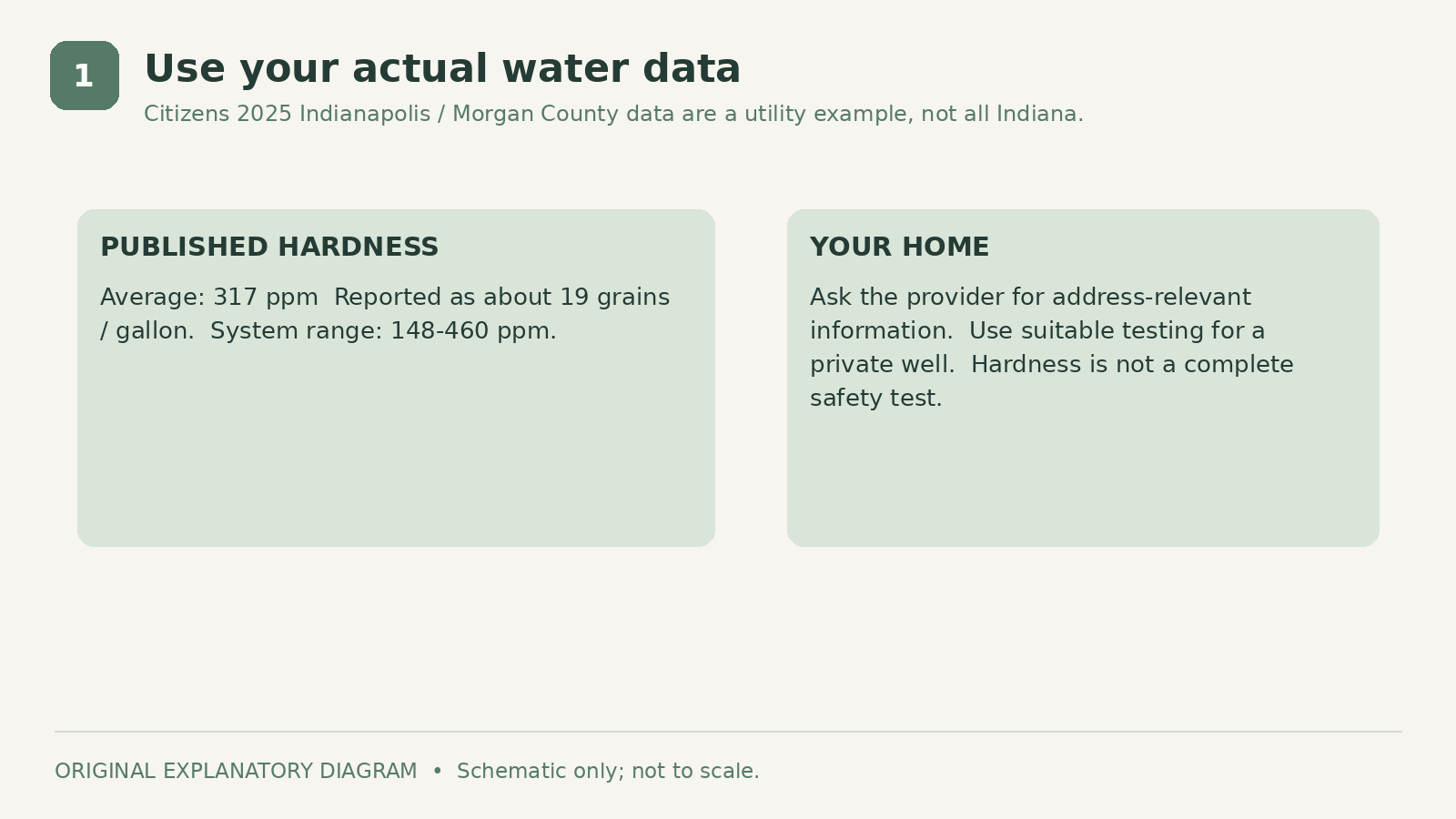
USGS explains water hardness primarily in terms of dissolved calcium and magnesium. Hardness itself is generally a nuisance issue rather than a health concern. That does not mean all water is safe; hardness and contamination are different questions.
For a local example, Citizens Energy Group's 2025 Indianapolis and Morgan County data report average hardness of 317 parts per million, shown as approximately 19 grains per gallon, with a system-wide range of 148 to 460 parts per million. Those are utility-system figures, not a measurement at every Indiana tap.
Ask your provider for information relevant to your address. If you use a private well, discuss appropriate testing with the local health department or a qualified water professional. A sales demonstration alone should not determine every treatment decision.
Record what is bothering you: scale on fixtures, spots on dishes, cleaning effort, or a specific appliance concern. Check whether the appliance manufacturer has water-quality requirements. A defined problem makes it easier to evaluate whether the proposed system addresses something you actually experience.
2. Choose equipment for a defined treatment goal
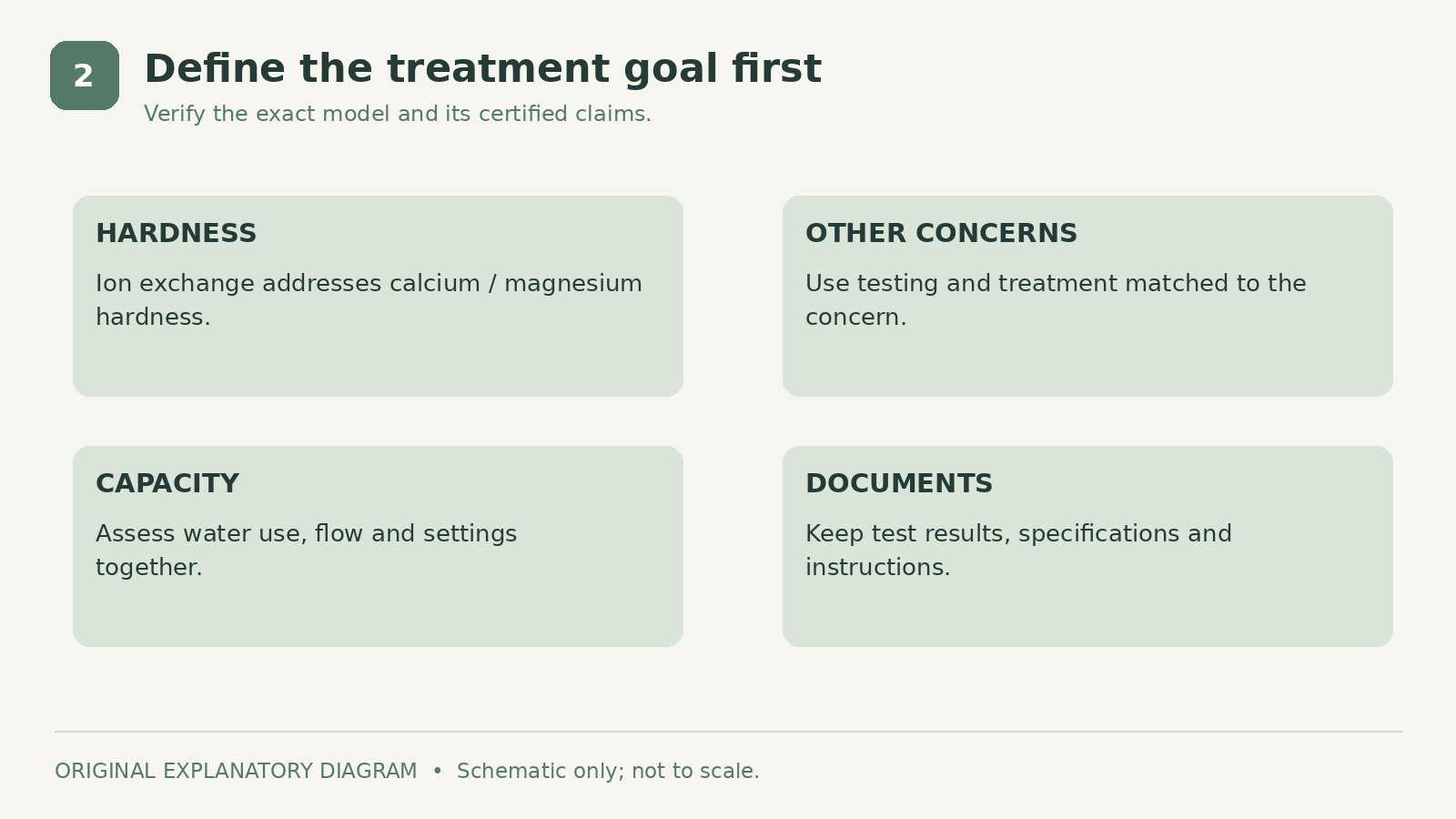
Ion-exchange softeners reduce hardness by exchanging ions. NSF's explanation of NSF/ANSI 44 describes the standard for residential cation-exchange softeners regenerated with sodium or potassium chloride. Verify the exact model's certification and claims rather than relying on a generic logo in a sales brochure.
A conditioner marketed as salt-free should not automatically be treated as equivalent to a system that removes hardness minerals. Ask what measurable outcome the product claims and what evidence supports it. Likewise, a drinking-water filter is not automatically a whole-house softener.
Ask the installer to explain capacity, expected flow, regeneration settings, and operating requirements in relation to your water test and household use. Nominal tank capacity alone does not tell you how the equipment will perform under your actual settings.
Identify which plumbing will be treated and which outlets, if any, will bypass the system. Have the plumber determine an appropriate arrangement; this guide is not a piping diagram. If you have concerns about sodium in drinking water, discuss the intended treatment with your clinician and qualified water professional before choosing a configuration.
Keep the original test results and product specification together for later comparison.
3. Compare equipment and installation charges
Angi's July 2026 Indianapolis cost page describes its local figures as estimates derived from national information and regional price indices. It lists labor at $550 to $1,100, but that is contextual guidance, not a measured price for your plumbing. Its broad technology categories also make the headline average unsuitable for precise system selection.
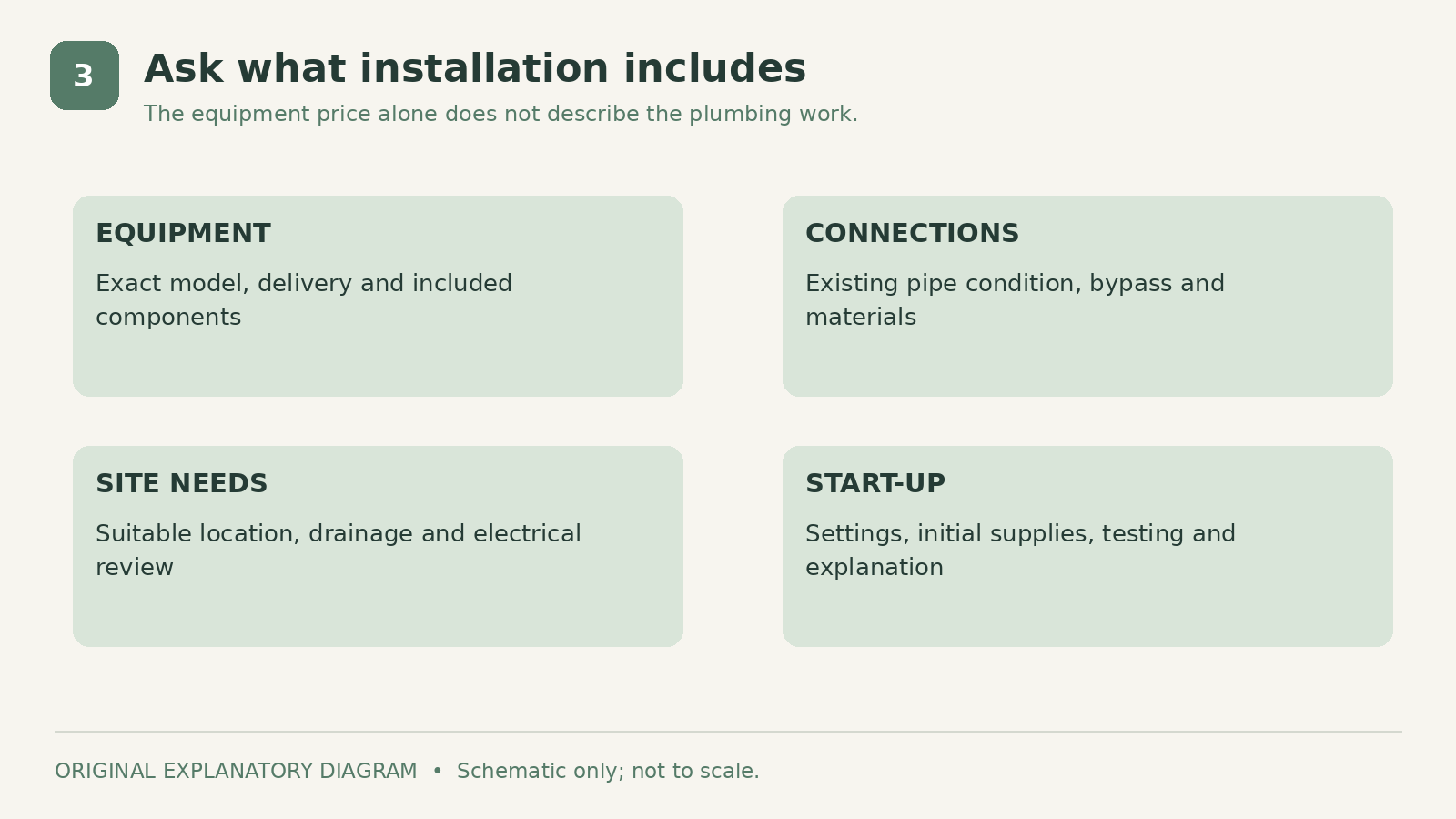
Request a quote that names the model and separates the installed scope. Ask whether delivery, bypass components, connection materials, start-up, initial supplies, removal of old equipment, and applicable approvals are included.
Replacing a unit in a suitable existing location can differ from creating a new installation point. Access, pipe condition, drainage arrangements, electrical needs, and the required discharge route should be assessed before you accept a firm total.
Have the installer confirm applicable local requirements and manufacturer instructions. Do not infer an approved discharge arrangement from a photograph or a neighbor's setup.
Also ask who will service the equipment. A low purchase price can be inconvenient if replacement parts, programming support, or qualified service are difficult to obtain where you live.
4. Build a transparent purchase and ownership budget
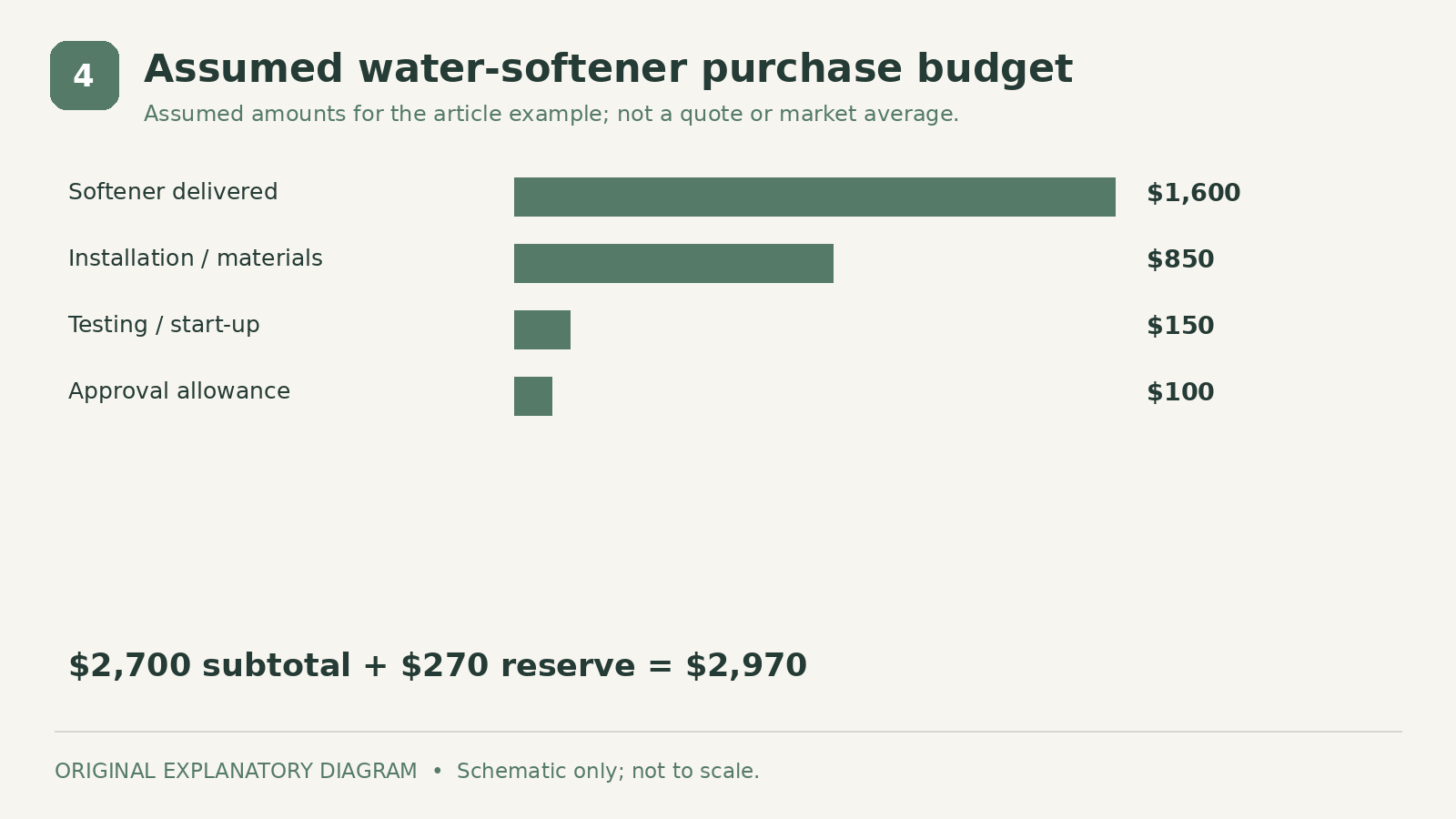
The following example assumes a straightforward new ion-exchange installation. It is an original planning exercise, not an Indiana average, a dealer price, or a recommended equipment specification. Amounts include the purchasing costs assigned to each line for this exercise.
| Feature | Assumed amount | |
|---|---|---|
| Selected softener, delivered | $1,600 | |
| Installation and connection materials | $850 | |
| Testing, start-up, and initial supplies | $150 | |
| Local approval allowance | $100 | |
| Subtotal | $2,700 | |
| Owner reserve, 10% | $270 | |
| Planning total | **$2,970** |
This example excludes major plumbing reconstruction, a new electrical circuit, unusual drainage work, additional contamination treatment, and financing. If a dealer bundles start-up or supplies into the equipment price, remove the duplicate allowance.
Create a second line for annual ownership costs. Ask the seller to estimate salt or regenerant use, water used during regeneration, scheduled maintenance, and likely service charges for your settings. Request the assumptions behind any claimed savings.
For illustration only, $180 per year in supplies plus $120 in service would equal $300 annually, or $1,500 over five years before price changes, utilities, repairs, or financing. Those are assumed figures, not promised operating costs. Keeping them separate makes a cash purchase, rental, or subscription easier to compare.
5. Decide whether the benefits justify the cost
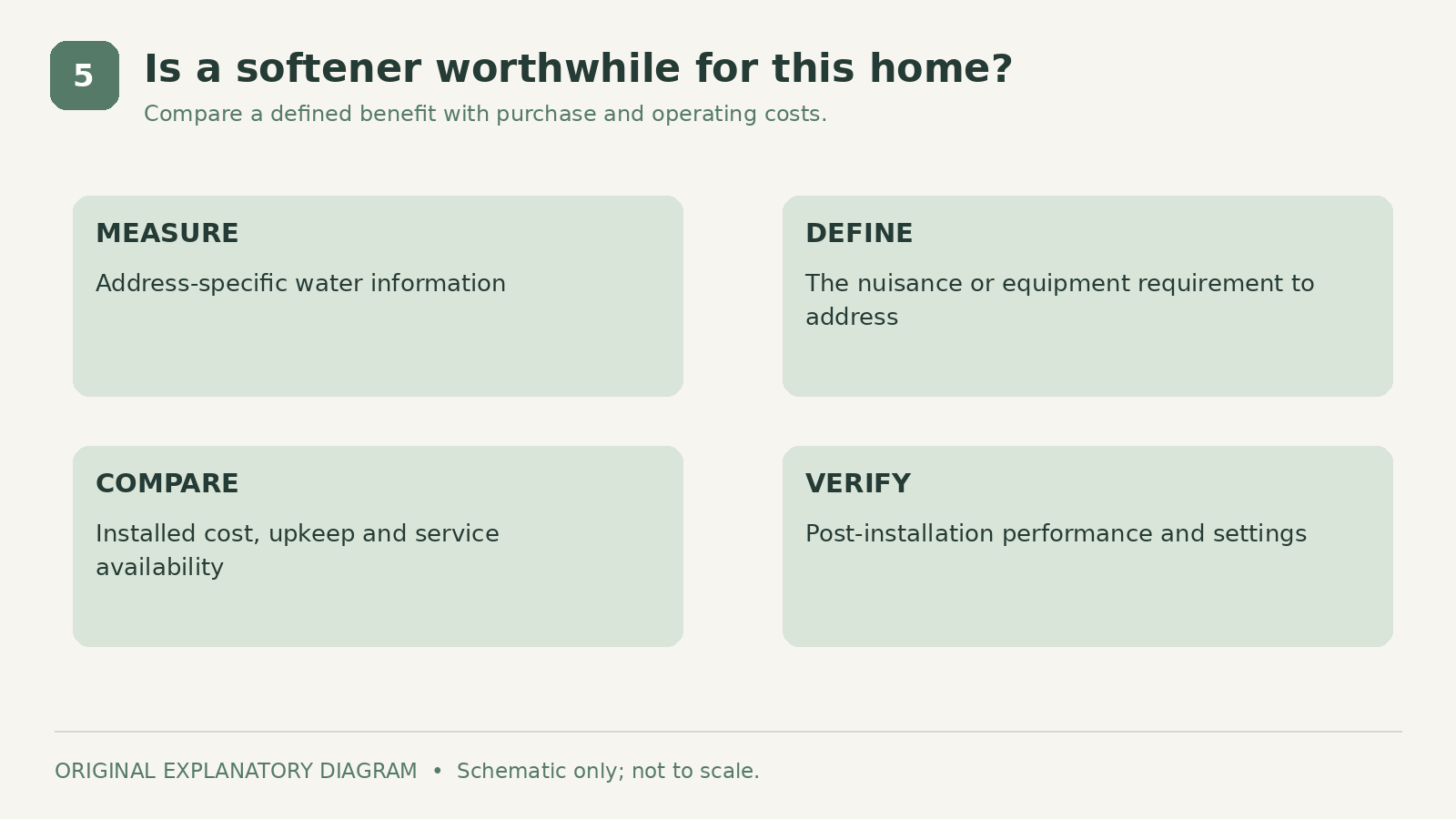
A softener may be a reasonable purchase when verified hardness creates enough inconvenience to justify the installed and ongoing costs. It may be less compelling when the household is comfortable with the current water and the sales case rests mainly on vague promises.
Ask for a clear acceptance check: what will be measured after installation, who will explain settings, and how performance concerns will be handled. Keep a record of raw-water and treated-water results without expecting the softener to prove unrelated contaminants are absent.
Compare outright ownership with any rental offer over the same period. Include installation, recurring fees, supplies, service, cancellation terms, and ownership at the end. A small monthly payment can conceal a large total commitment.
Before buying, gather three things: an address-specific water assessment, a model-specific treatment proposal, and a complete installed quote. That gives you a defensible decision based on your home, rather than the assumption that every Indiana household needs the same equipment.
Sources
- USGS explains water hardness. Checked October 7, 2026
- Citizens Energy Group's 2025 Indianapolis and Morgan County data. Checked October 7, 2026
- NSF's explanation of NSF/ANSI 44. Checked October 7, 2026
- Angi's July 2026 Indianapolis cost page. Checked October 7, 2026
Share this article
Get new guides by email
Practical home articles and free resources. No spam, and you can unsubscribe at any time.
Keep reading
HVAC Replacement Cost in Texas: Hidden Fees to Check
Compare Texas HVAC replacement costs and hidden-fee risks, with equipment scope, duct assessment, installation allowances, and current incentive cautions.
October 2026, 4 min read
How Much Does a Lanai Screen Enclosure Cost in Florida?
Compare Florida lanai screen enclosure scopes, screen-area versus footprint pricing, frame and mesh choices, and a transparent sample budget.
October 2026, 4 min read
Stucco Repair Cost in Arizona: What Homeowners Should Know
Understand Arizona stucco repair pricing, surface damage versus concealed moisture, access, finish matching, and an illustrated repair budget.
October 2026, 5 min read