What Is the Cheapest Way to Surface a Dirt Driveway?
Compare low-cost dirt-driveway surfacing with drainage, local aggregate, delivery, preparation and a transparent sample budget before choosing.
By Home Crane Editors. . 4 min read.
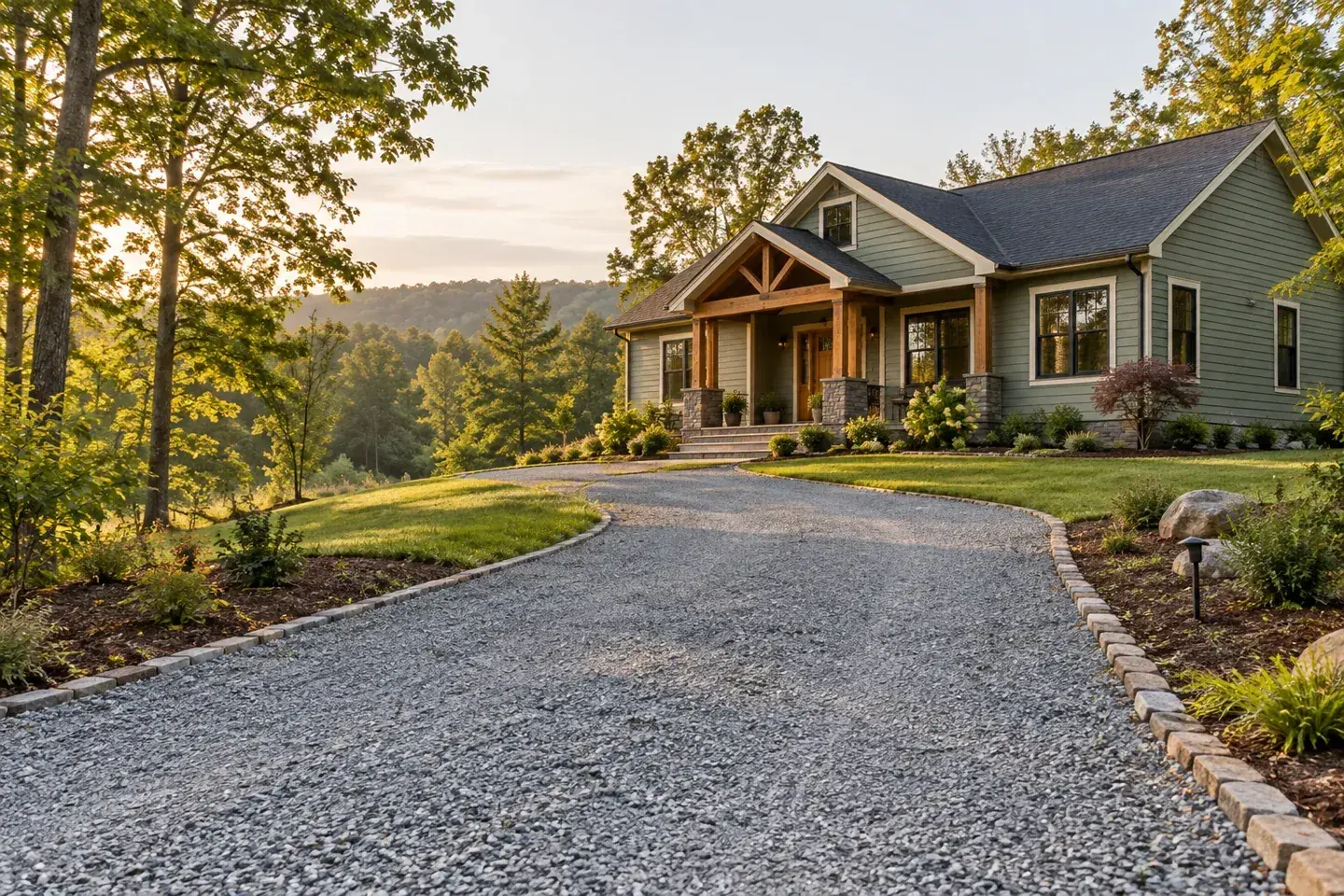
Locally available compacted crushed aggregate is often the lowest-cost practical surface for a dirt driveway, but it is not the same as a bound asphalt or concrete pavement. The cheapest workable choice depends on soil, drainage, slope, traffic, access, and delivery distance.
If you need a smooth bound surface, obtain local comparisons for suitable asphalt or other permitted systems. If your goal is simply a more usable driveway at a lower initial cost, properly designed aggregate is worth evaluating first. Dumping decorative gravel onto mud is not the same project.
Angi's 2026 gravel-driveway guide lists a broad $500–$3,500 project range. Without dimensions and site scope, that number cannot price a long rural driveway or major drainage repair. Treat it as published context and build your own estimate from quantities and work items.
1. Price the ground and drainage before the surface
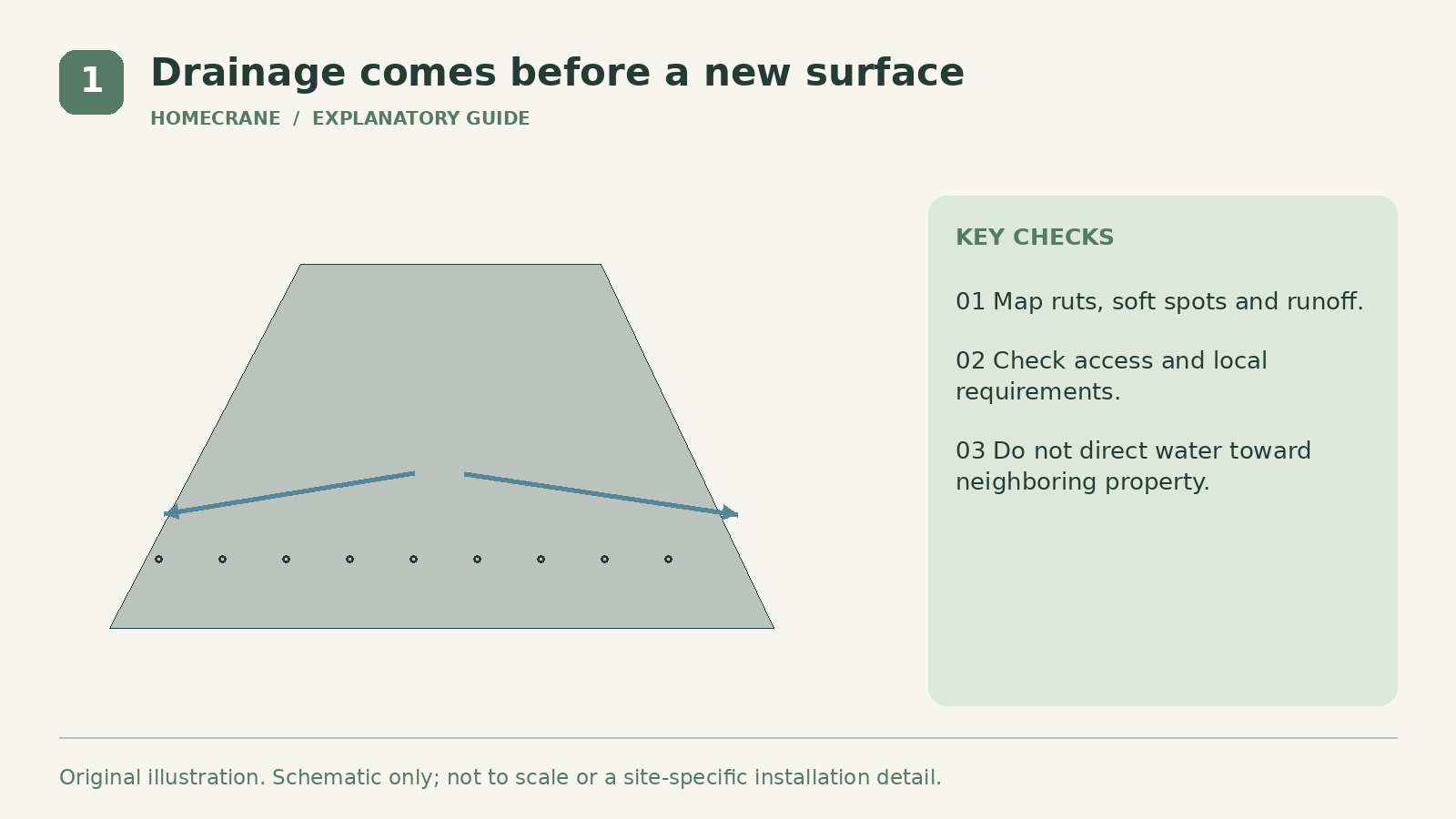
Observe the driveway after rain. Note standing water, ruts, erosion, soft spots, and runoff crossing from adjacent land. These conditions can consume new material quickly if they are not corrected.
A contractor should explain preparation, grading, drainage, and the aggregate section appropriate to the site. The required depth and material blend depend on the ground and loads. There is no universal thin layer that turns every dirt track into a durable driveway.
The Federal Highway Administration's drainage guidance links drainage maintenance with avoiding erosion and saturation of supporting layers. It is road-maintenance guidance, not a design for your driveway, but the principle explains why water management belongs in the budget.
Check local requirements for the road connection, culverts, grading, and stormwater. Do not redirect water onto a neighbor's property or into the house foundation area. Locate buried services before excavation through the appropriate local process.
2. Compare usable materials, not just the cheapest load
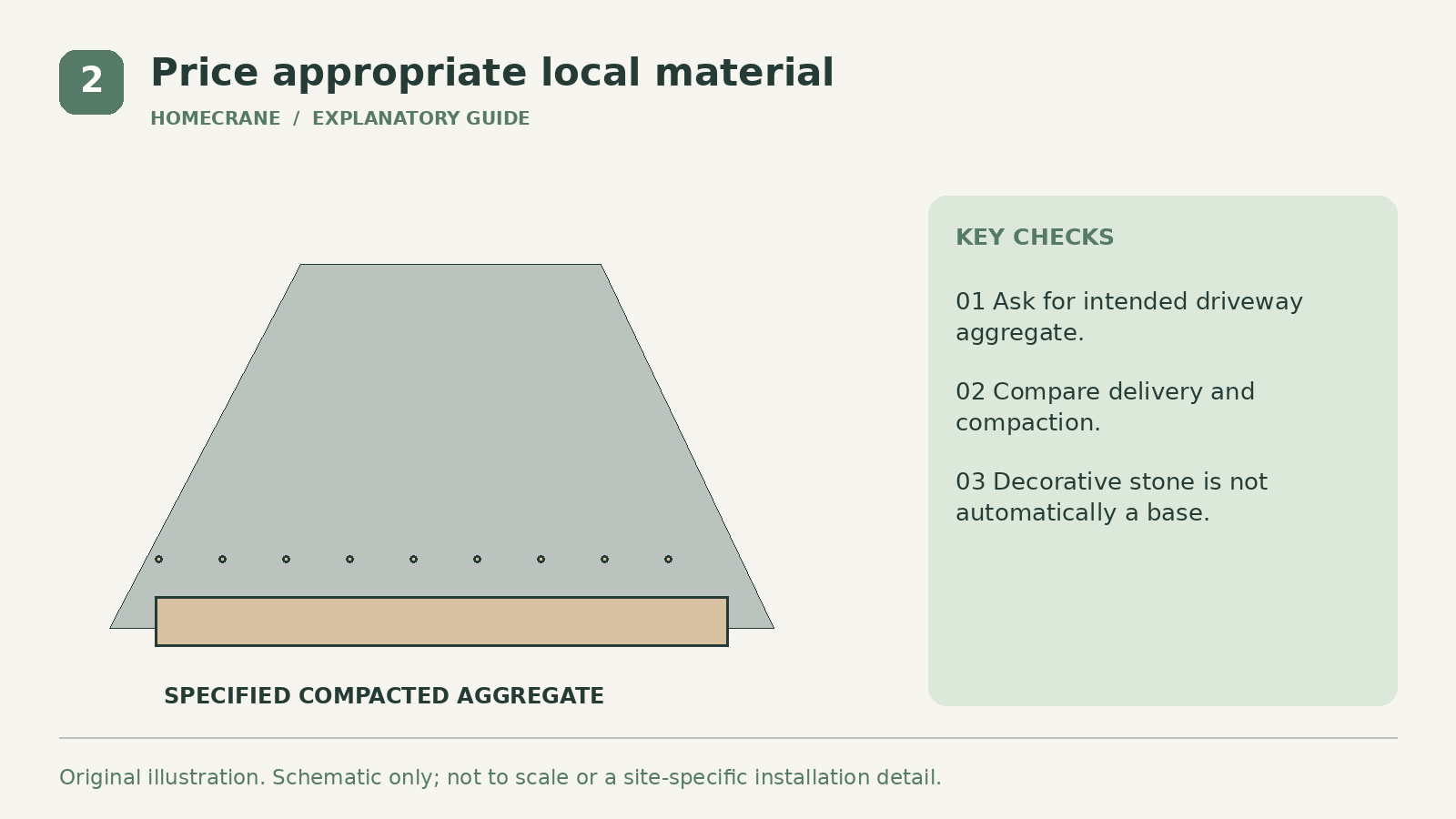
Ask local suppliers about aggregate intended for compacted driveway use. Regional product names vary, so request the grading or intended application rather than relying only on names such as crusher run or road base.
Rounded decorative pea gravel may shift more under tires and is not automatically the right structural surface. Recycled concrete or asphalt materials may be economical where quality, processing, and local approval are appropriate. Ask about contaminants, particle size, compaction, and maintenance.
FHWA's aggregate guidance highlights regional availability and transport as part of material planning. A low quarry price can lose its advantage after a long delivery haul or multiple small-load charges.
| Feature | What to compare | |
|---|---|---|
| Compacted crushed aggregate | Preparation, grading, delivery and recurring maintenance | |
| Suitable recycled aggregate | Quality, local acceptance and intended use | |
| Asphalt pavement | Complete base and installed pavement scope | |
| Concrete pavement | Preparation, thickness design, joints and installed scope |
Do not assume asphalt millings will automatically become equivalent to new hot-mix pavement. The result depends on the material and installation. Obtain an honest description of the finished surface and expected upkeep.
3. Calculate material volume and a complete sample budget
Measure the driveway length and width, dividing irregular shapes into manageable sections. For a simple volume example, assume a 12-foot-by-60-foot area and an average 4-inch compacted layer. The area is 720 square feet, and the volume is about 8.9 cubic yards before adjusting for compaction and delivery basis.
Those dimensions illustrate arithmetic only. Four inches is not a recommended section for every soil or traffic load. A supplier or contractor must determine the required layers and convert volume to tonnage using the actual material and compaction assumptions.
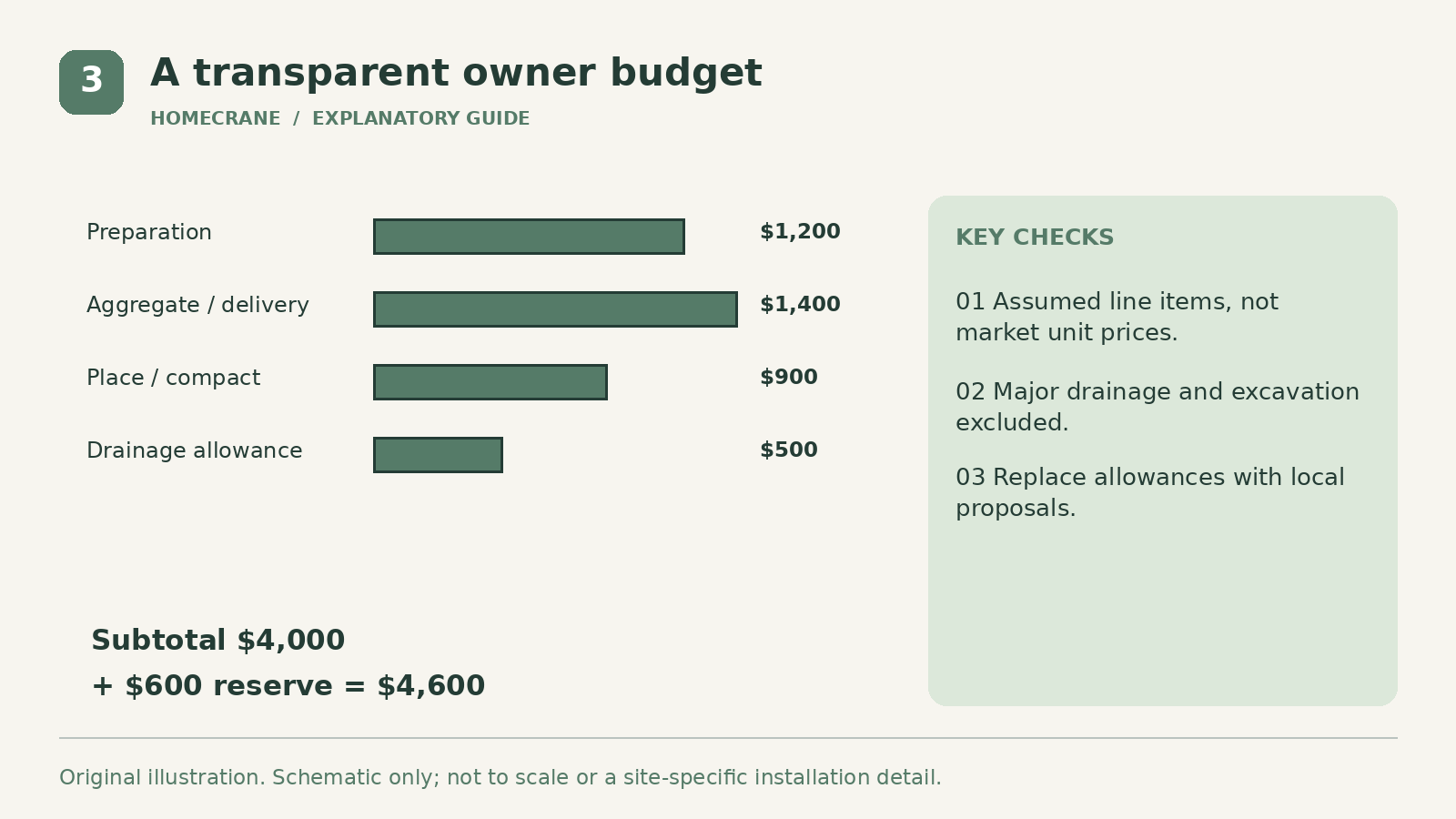
Here is a separate hypothetical budget, not researched unit pricing:
| Feature | Amount | |
|---|---|---|
| Site preparation and grading | $1,200 | |
| Aggregate and delivery | $1,400 | |
| Placement and compaction | $900 | |
| Limited drainage allowance | $500 | |
| Subtotal | $4,000 | |
| Owner reserve, 15% | $600 | |
| Illustrative total | $4,600 |
This scenario excludes major culverts, retaining work, extensive excavation, road permits, and unusual soil treatment. Its total is not tied to a universal per-square-foot rate. Replace each allowance with the actual local proposal.
Ask whether the quoted quantity is loose delivered material or a specified compacted result. That distinction helps prevent ordering by a simple geometric volume and discovering that the finished layer is thinner than intended.
4. Keep the inexpensive surface inexpensive to own
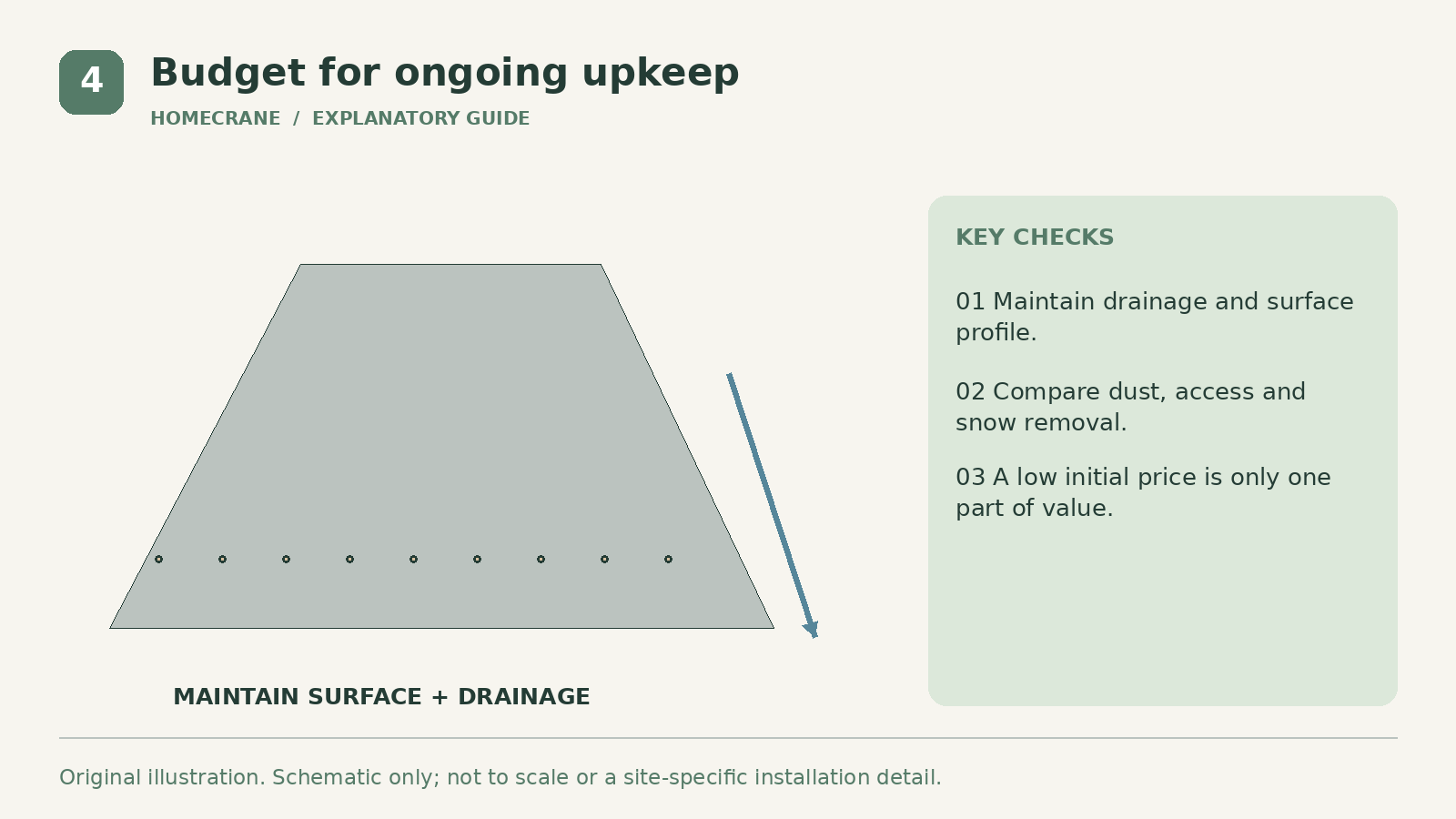
An aggregate driveway typically needs periodic attention to displaced material, potholes, grading, and drainage. Plan that work rather than treating it as an installation failure every time a wheel track develops.
Keep drainage routes functional and correct small washouts before they grow. Use equipment and methods appropriate to the driveway; indiscriminate scraping can remove the useful surface material or worsen the profile. Steep or frequently eroding sites may need a different design.
Compare the initial saving with your tolerance for dust, loose stones, snow removal, walking comfort, and maintenance. A household using mobility aids may value a firm bound route even if the main driveway remains aggregate.
Obtain bids with the same dimensions, preparation assumptions, material description, compacted section, and restoration scope. The lowest number is meaningful only when it describes a usable finished driveway.
Is gravel technically paving?
People often use the word loosely, but an unbound aggregate surface differs from asphalt or concrete pavement. Tell contractors which result you want so the quotes are comparable.
Can I skip excavation and just spread stone?
Sometimes an existing sound base only needs maintenance material. Soft soil, vegetation, drainage defects, or a new driveway may need much more preparation. Have the site assessed before choosing the shortcut.
What saves money without undermining the work?
Use appropriate local material, combine deliveries where practical, limit the footprint to actual needs, and solve drainage early. Avoid reducing essential preparation merely to afford a decorative surface.
Sources
- Angi's 2026 gravel-driveway guide. Checked October 11, 2026
- Federal Highway Administration's drainage guidance. Checked October 11, 2026
- FHWA's aggregate guidance. Checked October 11, 2026
Share this article
Get new guides by email
Practical home articles and free resources. No spam, and you can unsubscribe at any time.
Keep reading

7 Modern Concrete Driveway Border Paver Ideas
Explore modern concrete driveway border paver ideas, including brick, double-row, contrasting-color, patterned, natural stone, square, and cobblestone designs.
November 2026, 11 min read

9 Cheap Gravel Driveway Edging Ideas DIY
Explore nine cheap DIY gravel driveway edging ideas using natural stone, concrete blocks, timber, metal, brick, river rock, recycled plastic, and more.
November 2026, 13 min read
Driveway Materials and Drainage: What Happens to the Rain
A driveway is one of the largest hard surfaces on most residential lots, which makes its drainage worth planning. Here is how solid and permeable driveway materials compare, using EPA and state stormwater guidance.
September 2026, 3 min read