Driveway Materials and Drainage: What Happens to the Rain
A driveway is one of the largest hard surfaces on most residential lots, which makes its drainage worth planning. Here is how solid and permeable driveway materials compare, using EPA and state stormwater guidance.
By Home Crane Editors. . 3 min read.
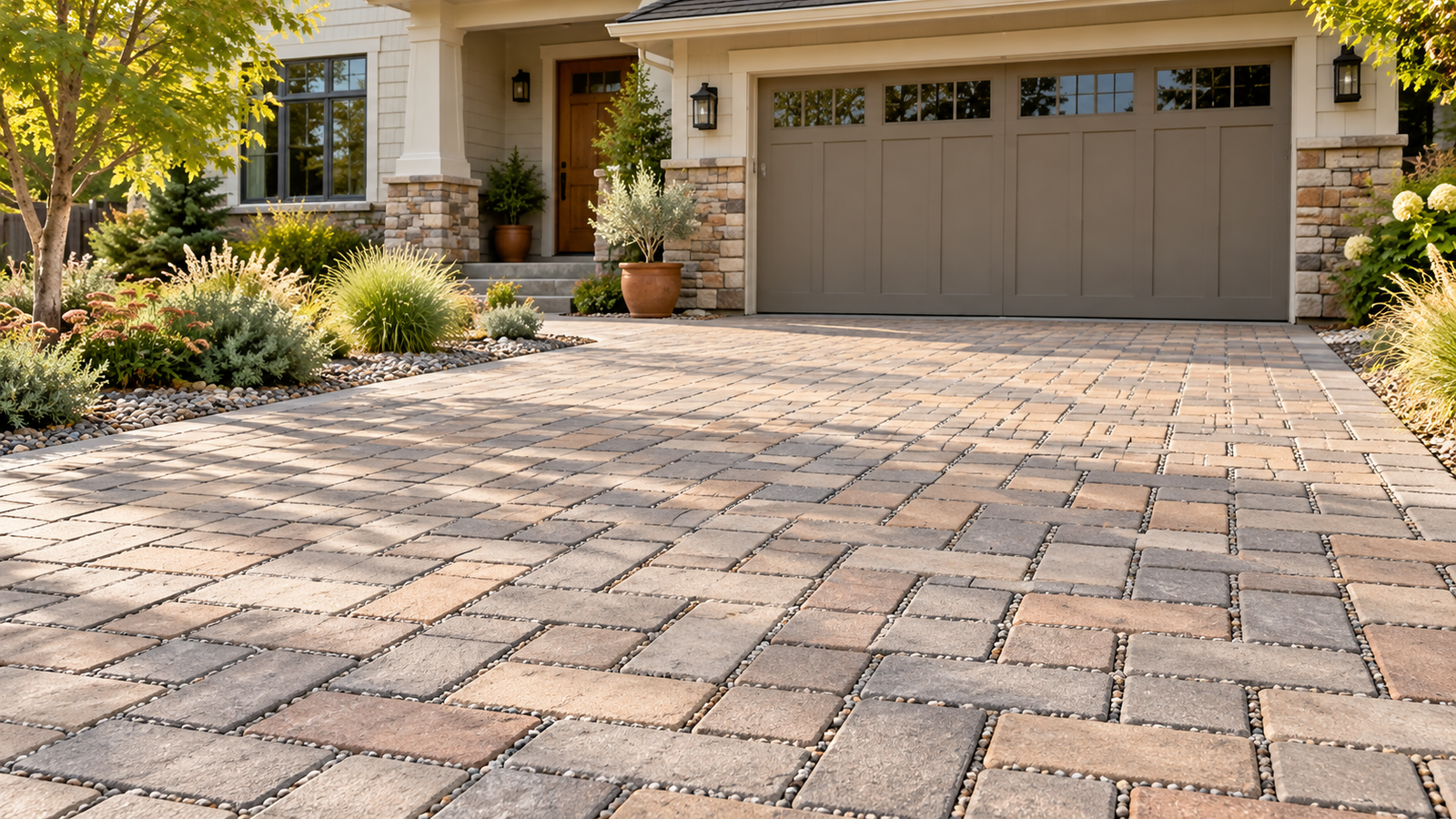
Conceptual illustration of a permeable paver driveway.
A typical residential driveway is one of the largest continuous hard surfaces on a home's lot, which makes it a meaningful piece of how a property handles rainwater. The same distinction that applies to patios applies here: solid materials like poured concrete and standard asphalt shed water off the surface, while permeable materials, including pervious concrete, porous asphalt and permeable interlocking pavers, are designed to let water filter through into a stone reservoir below. Our patio drainage article covers the underlying mechanics in more depth. This one focuses on what is specific to driveways.
Why driveways carry more weight, literally
A driveway is not just a bigger patio. It carries vehicle loads, which changes what a permeable system needs underneath it. The Minnesota Pollution Control Agency's technical overview of permeable pavement describes the underlying stone reservoir layer as providing both water storage and structural support, and notes that permeable systems have been used at residential sites including driveways specifically, not just walkways and patios. Getting the reservoir depth and stone specification right for vehicle loads is a design question, which is why the same MPCA guidance and other stormwater sources consistently recommend involving a qualified contractor or engineer for a permeable driveway installation rather than treating it as a straightforward do-it-yourself project.
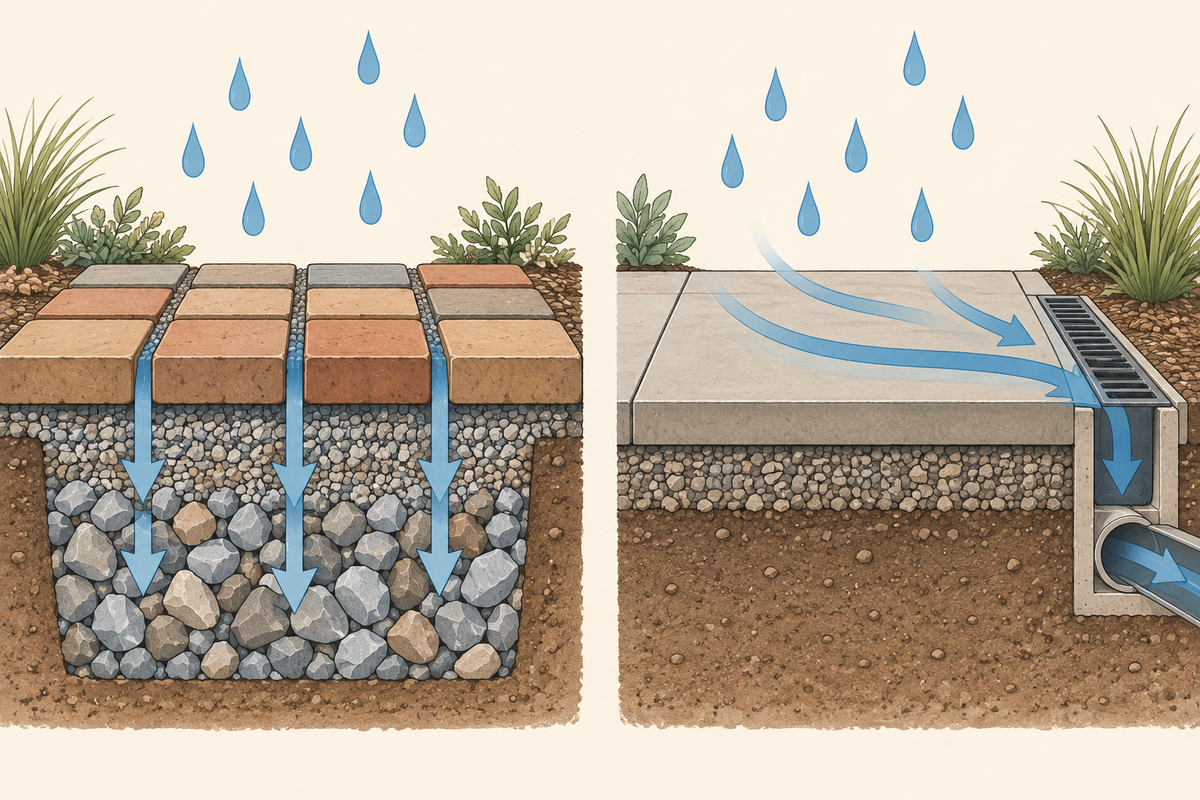
Where the runoff goes matters
A large solid driveway sheds a significant volume of water toward wherever it is graded, often the street, a storm drain, or a low point in the yard. State stormwater guidance, such as materials distributed through Nebraska's stormwater education program, explains that runoff crossing hard surfaces gains speed and can carry sediment and debris into local waterways. A steeply sloped or poorly graded driveway can also direct water toward a home's foundation, which is a separate and more immediate concern than regional stormwater management.
| Feature | Why it matters | |
|---|---|---|
| Slope and grading | Directs water toward the street or yard, not toward the house foundation | |
| Where water exits at the bottom | A driveway that empties onto a sidewalk or neighbor's property can create disputes or hazards | |
| Local stormwater rules | Some municipalities regulate impervious surface coverage on a lot, which can affect driveway size or material choice | |
| Freeze-thaw exposure in cold climates | Affects material choice and expected lifespan for both solid and permeable options |
What each material generally offers
- Poured concrete. Durable and long-lasting when properly reinforced and cured, but a fully solid surface unless a permeable mix is specified.
- Standard asphalt. Common, relatively economical to install, and also fully solid in its standard form.
- Permeable interlocking pavers. Individual units laid over a stone base with open joints, allowing water to pass between them. Higher upfront cost is typical, offset in some cases by reduced need for separate stormwater infrastructure.
- Pervious concrete or porous asphalt. A specialty mix with built-in void space, requiring a contractor experienced with the material to install correctly.
- Gravel. The simplest permeable option, low upfront cost, but requires periodic regrading and is less common for a primary driveway in many neighborhoods due to appearance preferences and some local rules.
Winter climates add another variable
In regions with freeze-thaw cycles, driveway material choice intersects with winter maintenance. A solid surface is generally more straightforward to plow and to treat with ice melt products. Some permeable paver systems can also be plowed, but manufacturers often have specific guidance on snow removal equipment and de-icing products to avoid damaging the joints between pavers. If you are considering a permeable driveway in a cold climate, ask the installer directly about winter maintenance requirements before committing to the material, since this is a detail easy to overlook when comparing systems in a showroom or during a summer install.
Local rules can affect the choice
Some municipalities set limits on how much of a residential lot can be covered by impervious surface, particularly in areas with known stormwater or flooding concerns. A permeable driveway can sometimes count differently toward that limit than a solid one, which is worth asking your local planning or public works department about if your property already has a lot of paved area, such as a large patio or an extended parking pad.
Estimating materials
Once you have chosen a material and confirmed the design with a qualified contractor, our concrete calculator and gravel calculator can help estimate quantities for a slab or base, though neither replaces a contractor's structural design for a surface that will carry vehicle loads.
Your takeaway: before choosing a driveway material, look at how water currently moves across your lot, ask whether your municipality has impervious surface rules that affect you, and if you are considering a permeable system, bring in a contractor experienced with the structural side of it, not just the surface material.
Frequently asked questions
Can I install a permeable driveway myself?
The surface materials are sometimes DIY-friendly, but the reservoir base underneath needs to be engineered to support vehicle loads correctly. Most stormwater guidance recommends a qualified contractor for the full system, not just the visible surface.
Do all municipalities regulate driveway drainage?
No, but many do, particularly around impervious surface coverage limits or runoff onto neighboring property or public sidewalks. Check with your local planning or public works department.
Sources
- Overview for permeable pavement, Minnesota Pollution Control Agency. Checked September 24, 2026
- Soak Up the Rain: Permeable Pavement, U.S. EPA. Checked September 24, 2026
- Permeable Pavement (fact sheet), Nebraska Department of Environmental Quality funded program. Checked September 24, 2026
Share this article
Get new guides by email
Practical home articles and free resources. No spam, and you can unsubscribe at any time.
Keep reading

7 Modern Concrete Driveway Border Paver Ideas
Explore modern concrete driveway border paver ideas, including brick, double-row, contrasting-color, patterned, natural stone, square, and cobblestone designs.
November 2026, 11 min read

9 Cheap Gravel Driveway Edging Ideas DIY
Explore nine cheap DIY gravel driveway edging ideas using natural stone, concrete blocks, timber, metal, brick, river rock, recycled plastic, and more.
November 2026, 13 min read

What Is the Cheapest Way to Surface a Dirt Driveway?
Compare low-cost dirt-driveway surfacing with drainage, local aggregate, delivery, preparation and a transparent sample budget before choosing.
October 2026, 4 min read